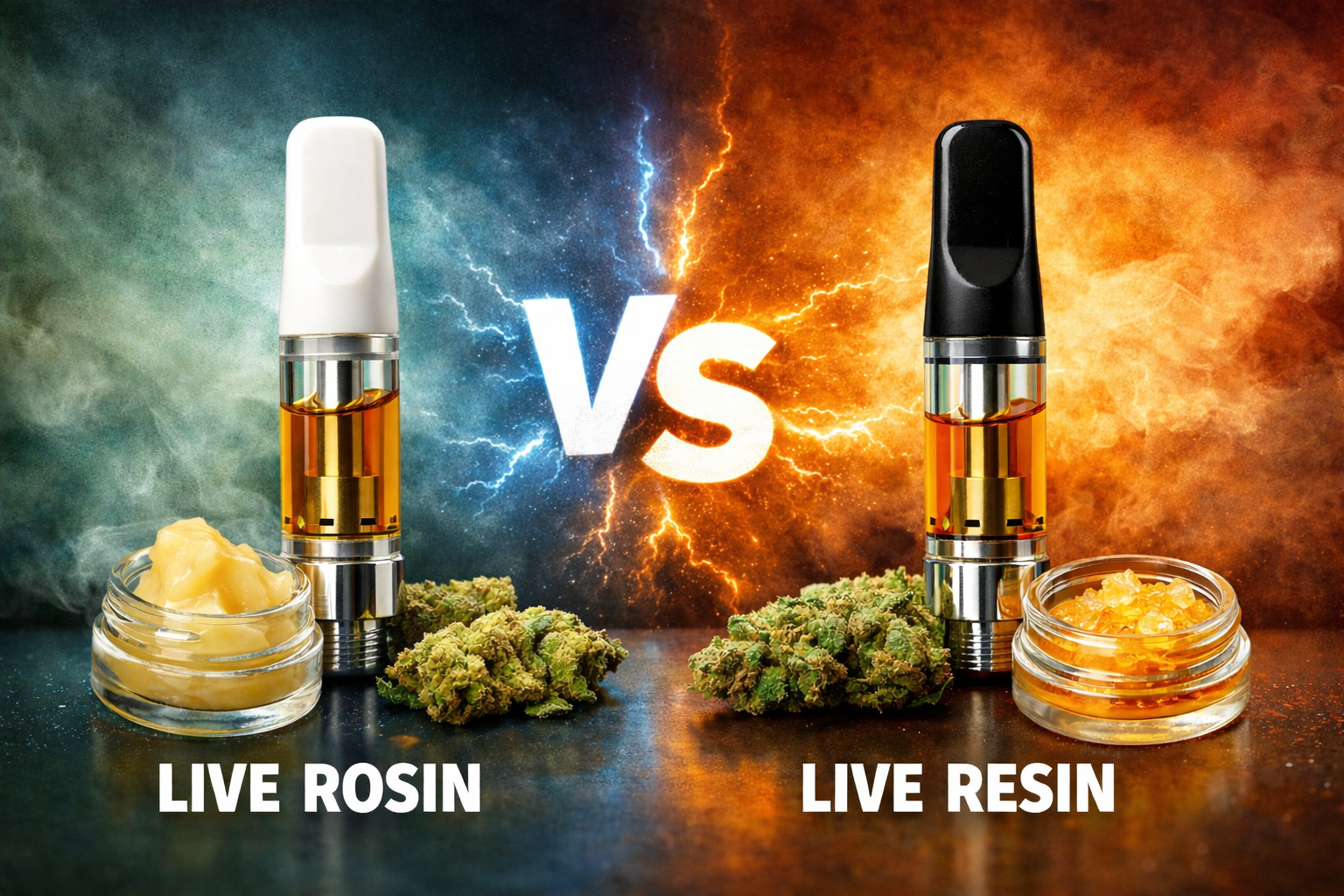
Live rosin and live resin carts both use fresh frozen cannabis, but extraction changes everything. Solventless pressing and hydrocarbon extraction preserve terpenes differently, shaping flavor, aroma, and how the effects feel.
 Photo by: Gina Coleman/Weedmaps
Image lightbox

Ask ten people in the hash world to define the difference between live rosin and live resin, and most will start with the same word: process. They're right, but it undersells how much that one fork in the road, mechanical pressure versus solvent, ends up dictating everything downstream: flavor, viscosity, hardware behavior, shelf life, the culture around it and price.
Both categories start from the same place. Fresh frozen cannabis, flash-frozen at harvest instead of dried and cured. That single step is what unlocks the "live" designation, and it's the reason both live rosin and live resin carts taste closer to the plant than standard cured concentrates. Drying and curing burn off volatile terpenes before extraction even begins. Freezing skips that loss entirely.
Solventless vs. solvent: the real fork in the road
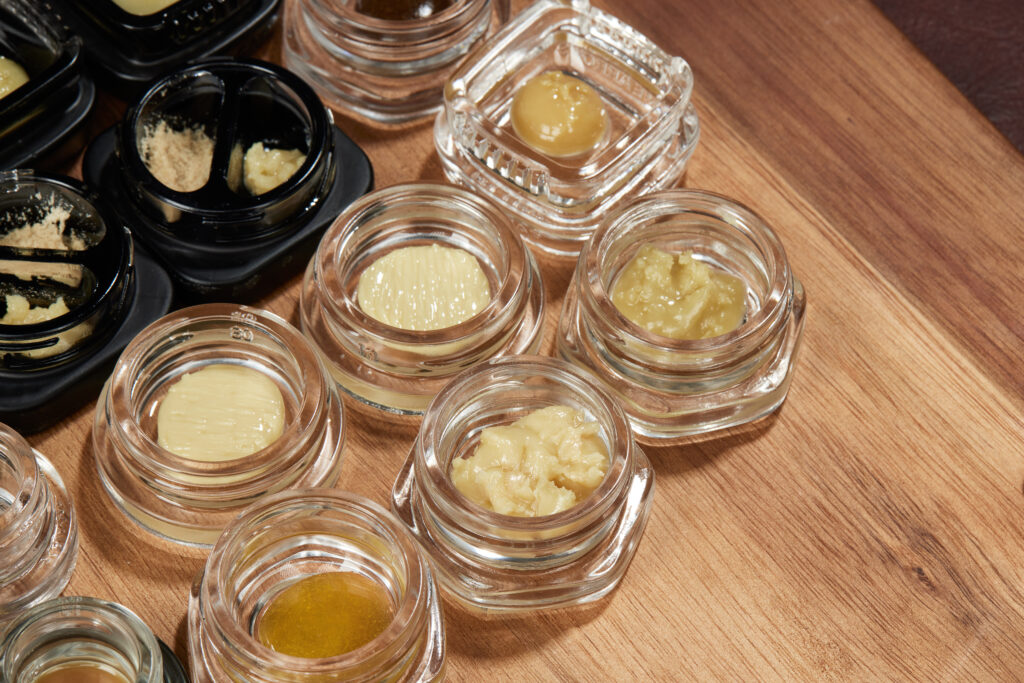
Live rosin is squeezed, not dissolved. Heat and pressure, applied to bubble hash washed from fresh frozen flowers, force oil out of the trichome heads with nothing but mechanical force. No butane, no propane, no closed-loop system. What comes off the plates is the rosin.
Live resin runs the opposite playbook. A closed-loop hydrocarbon rig strips cannabinoids and terpenes using butane or propane at low temperatures, then purges the solvent out afterward. Done right and lab-tested, it's a clean, dialed-in process. Still chemistry doing the separating though, not pressure.
One favors purity of process. The other favors yield.
Why rosin carts cost more (and why that's not a marketing trick)

Image lightbox

This is where people in the space roll their eyes at "value" framing. Rosin's price tag isn't padding, it's math. Solventless pressing pulls a smaller percentage of available oil from the same starting material, and it takes a lot more labor and skill to do it well. Hydrocarbon extraction scales. A rosin press doesn't scale the same way. Every batch is still a function of how good the hash or flower going in actually was, and how dialed the press operator's temp and pressure curve is.
That's why a well-made live rosin cart commands a premium most resin carts don't touch. You're paying for inefficiency on purpose, the kind that protects the terpene profile instead of maximizing throughput.
Flavor: where the gap actually shows up
 Photo by: Gina Coleman/Weedmaps
Image lightbox

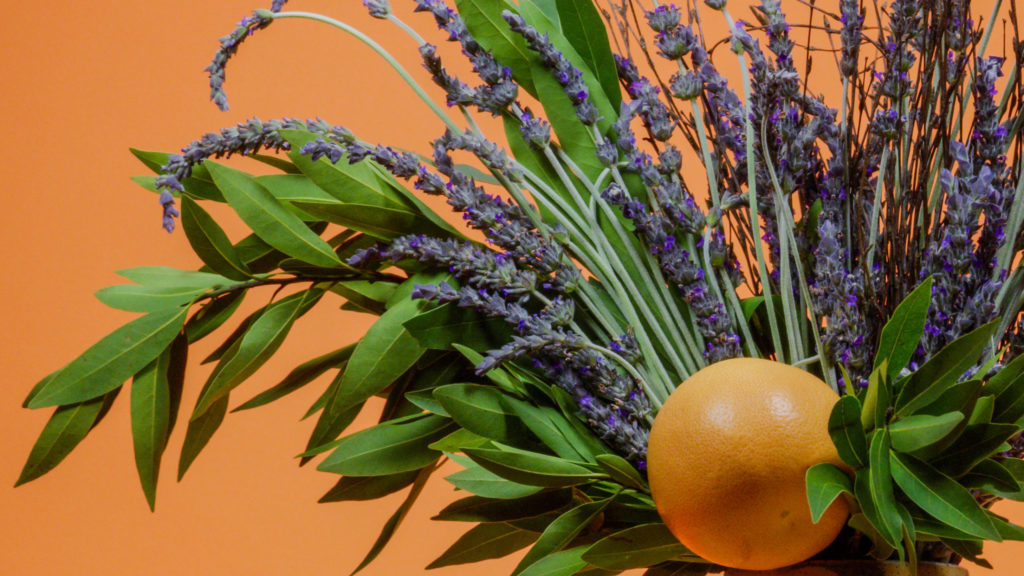
Terpenes are fragile. Every extra step they survive, solvent exposure, purging, distillation, is another chance for them to shift or flatten. Mechanical pressing skips most of those steps, which is why live rosin tends to land as more layered, more dimensional, closer to what the flower itself smelled like fresh off the plant.
Live resin isn't flavorless by any stretch. A well-extracted, well-purged batch can be loud and expressive. But it's gone through more processing steps than rosin has, and that adds up. Extraction method sets the ceiling, but cart hardware and voltage decide whether you actually taste it. A low-voltage rosin cart pulled too hard on cheap hardware will underperform a clean, well-formulated resin cart every time.
Potency vs. profile, not potency vs. quality
Resin carts often test a few points higher on THC, partly because hydrocarbon extraction is more efficient at stripping cannabinoids wholesale. Rosin carts can run slightly lower on the label while still carrying a fuller spread of minor cannabinoids and native terpenes, since less of the original chemistry gets stripped out or left behind in processing.
Neither number tells you how something actually hits. A high-THC resin cart can feel sharp and single-note. A lower-THC rosin cart can feel rounder and more "whole plant." Anyone who's judged hash competitions already knows this in their bones. The panel score is never just the THC percentage on the Certificate of Analysis (COA). It's appearance, aroma, melt, and how the experience actually unfolds.
Hardware: rosin punishes bad habits

Image lightbox

LiveLive rosin oil is thicker. That viscosity is a feature, evidence of a fuller terpene and lipid profile, but it makes rosin carts genuinely more particular about hardware. Crank the voltage past 2.2V and you'll cook the flavor right out of it. Pull too hard or too fast and you risk clogging the airpath. The sweet spot tends to sit around 1.8 to 2.2V, and that's not a suggestion. It's the difference between tasting what you paid for and torching it.
Live resin behaves better across a wider range of devices and settings. It's simply the more forgiving format, better suited to someone who wants to grab a cart and not think about it.
Storage: plan around how you actually use it

Image lightbox

Both formats want the same basics: cool, dark, upright. But because rosin holds onto more of its original volatile compounds, it's also got more to lose if it sits around getting warm. A rosin cart that's been baking in a hot car for a week will taste noticeably flatter than the day it was filled. Resin tends to hold a more consistent baseline over time, even with mediocre storage habits.
If you're going to actually finish a cart within a few weeks, rosin's volatility is a non-issue. If a cart's going to sit in a drawer for months, resin is the safer bet.
What it comes down to

Live rosin and live resin both start with fresh frozen cannabis and both deliver more strain-specific flavor than cured concentrate ever could. Past that, they're built around different priorities entirely. Rosin chases purity of process and accepts the cost and fragility that comes with it. Resin chases efficiency and scale, and trades a little nuance for consistency and accessibility.
Neither is the better concentrate. They're answering different questions. The only mistake is treating them like the same product with different price tags.
Find live rosin and live resin vape carts available for pickup or delivery from dispensaries near you on Weedmaps.