Infused pre-rolls deliver higher potency, but the internal structure isn't stable. As concentrates shift through the flower over time, airflow becomes uneven, burns become inconsistent, and potency delivery changes from hit to hit.
 Photo by: Gina Coleman/Weedmaps
Image lightbox

Infused pre-rolls promise more potency, but inside the joint, consistency is harder to maintain.
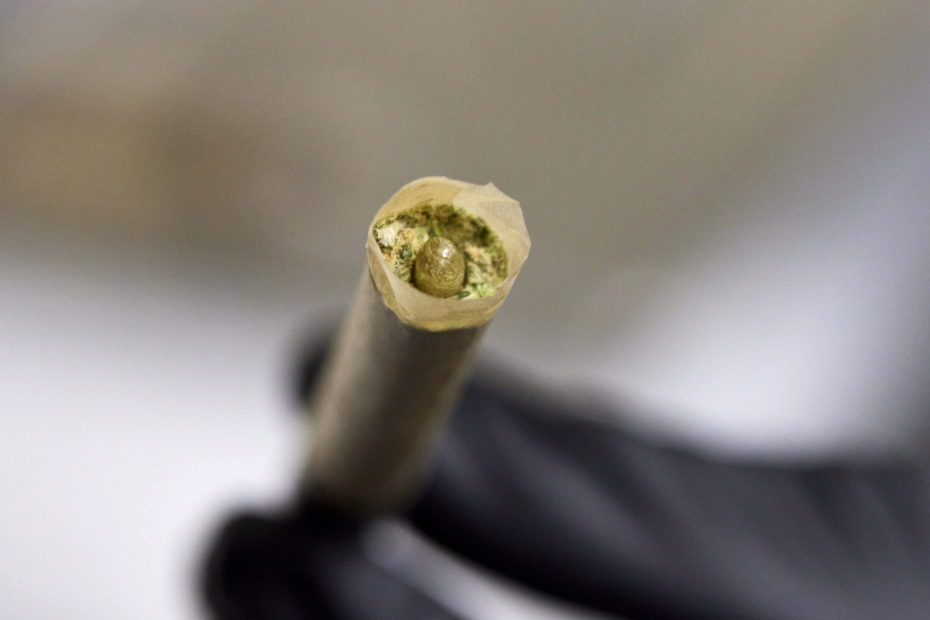
They combine flower and concentrates, but those materials don't behave the same over time. Differences in density and viscosity cause concentrates to move through the joint, which affects airflow, burn consistency, and how potency is delivered.
Flower and concentrates don't stay evenly distributed after production. Flower is dry and fibrous, while concentrates are dense and become more mobile under heat. Over time, these materials redistribute, especially with temperature changes or movement.
This internal instability explains why infused pre-rolls often burn inconsistently.
What infused pre-rolls combine
Infused pre-rolls layer materials with different physical properties:
- Ground cannabis flower
- Concentrates like oil, distillate, kief, or hash
Flower creates structure and airflow, while concentrates add density and potency. This combination creates an uneven system from the start, even before storage or handling comes into play.
Why material shifting happens
Material shifting happens because these components respond differently to heat, gravity, and movement—not because they fully separate into clean layers.
Concentrates soften with heat and become more mobile. As they move through the porous structure of the flower, they settle into denser pockets. Over time, this creates uneven distribution instead of a consistent mix.
How concentrates move during storage
 Photo by: Gina Coleman/Weedmaps
Image lightbox

As infused pre-rolls sit, concentrates migrate toward areas of least resistance.
They often:
- Settle toward the bottom of the pre-roll
- Pool in specific sections of the paper
- Accumulate near the tip or filter depending on storage position
Oil-heavy infused pre-rolls tend to shift more than kief-coated or hash-infused versions, which stay more evenly distributed. This creates concentrated zones instead of an even internal structure.
Impact on airflow
Airflow depends on uniform density.
When concentrates saturate certain sections, they block airflow and create resistance, while other areas remain loose and allow more air to pass through. The result is an uneven draw that changes from hit to hit instead of staying consistent.
Impact on burn consistency
Uneven distribution leads directly to uneven combustion.
Dense, concentrate-heavy sections burn slower due to restricted airflow. Lighter sections burn faster, creating hot spots and uneven burn lines. This imbalance is why infused pre-rolls are more prone to canoeing than standard joints.
Potency delivery and inconsistency
 Photo by: Gina Coleman/Weedmaps
Image lightbox

Potency becomes uneven when distribution shifts.
Instead of delivering consistent cannabinoid levels, the joint produces stronger and weaker pulls depending on which section is burning. One section may hit significantly harder, while another burns lighter than expected.
This reduces predictability and changes how the experience unfolds.
The role of temperature and handling
Temperature accelerates internal movement.
Heat softens concentrates, making them easier to redistribute, while cooling causes them to settle into new positions. Repeated temperature changes amplify this effect. Storage conditions play a major role, especially in warmer environments.
Handling also contributes. Movement and vibration shift internal material, particularly in loosely packed pre-rolls.
Can this be prevented?
Manufacturing can improve distribution, but it cannot fully stabilize it.
Even packing, fine grinding, and controlled infusion reduce large imbalances. Some products use external coatings instead of internal mixing to avoid internal shifting. These approaches improve consistency, but they don't eliminate movement entirely.
Any system that combines materials with different physical properties will change over time.
The bottom line

Infused pre-rolls trade consistency for potency.
Differences in density and temperature response cause concentrates to shift inside the joint, disrupting airflow, burn consistency, and potency delivery. That internal movement defines how these products actually perform—not just what's listed on the label.
Find infused cannabis products near you on Weedmaps.