Liquid diamonds chase concentrated potency, while live resin puts fresh-frozen flavor and aroma first. Knowing how each is formulated can help you look past the marketing and choose the concentrate that fits your priorities.
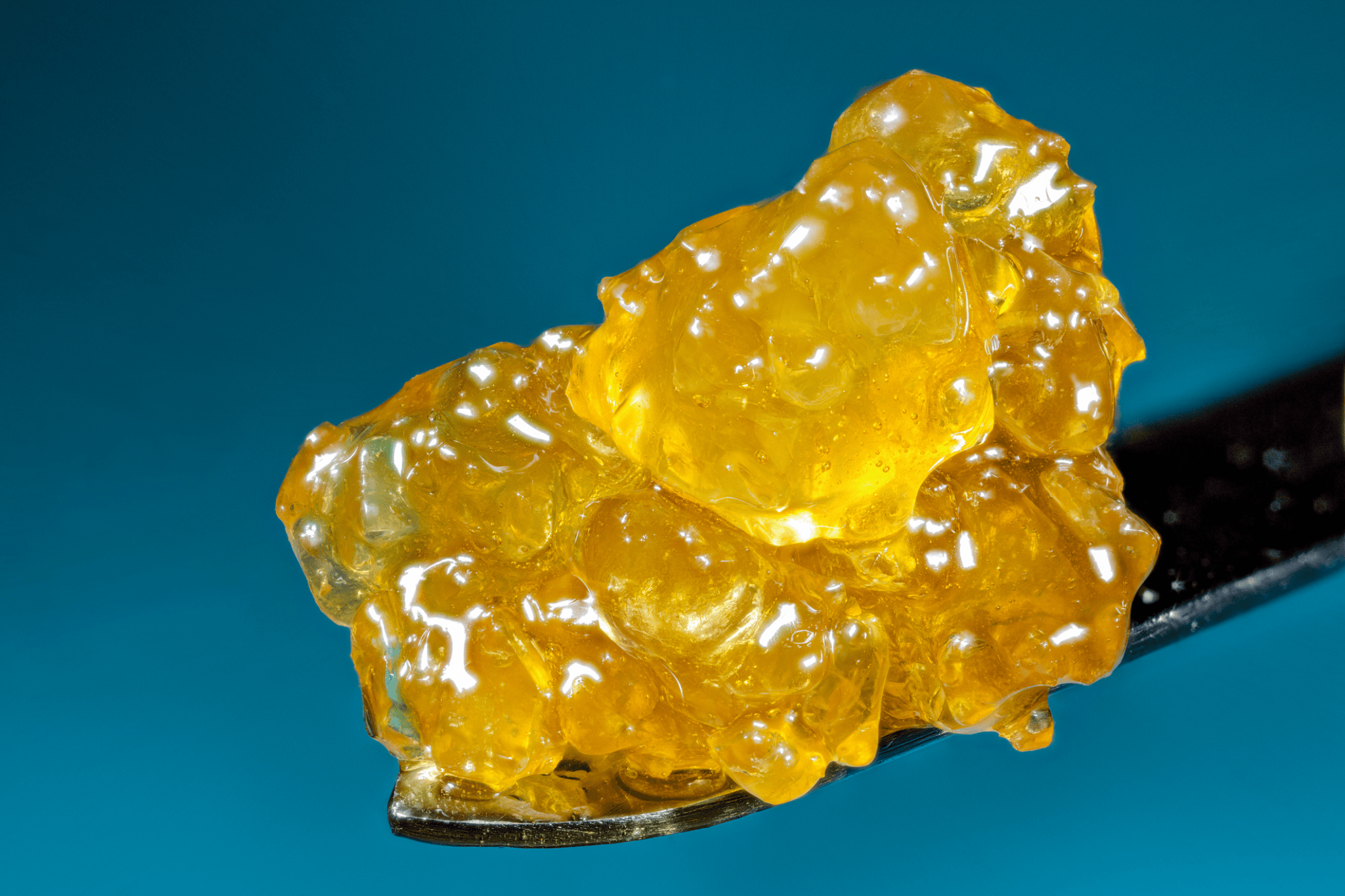 Photo by: Gina Coleman/Weedmaps
Image lightbox

Liquid diamonds and live resin can start in the same place: fresh-frozen cannabis. The difference is what happens next. Liquid diamonds are often made by separating highly concentrated THCA crystals from live resin and melting or dissolving them into terpene-rich sauce, while live resin keeps more of the plant's natural cannabinoid and terpene profile intact.
If you're trying to decide between the two, the choice usually comes down to what matters most to you. Are you looking for maximum potency, or do you care more about flavor and preserving more of the plant's original character? We'll break down how each concentrate is made, how they compare, and which one might be the better fit for your preferences.
What are liquid diamonds?
Liquid diamonds are a cannabis concentrate made by combining cannabinoids refined from crystalline THCA with a terpene-rich sauce, creating a potent, pourable extract. The "diamonds" are highly purified THCA crystals before they are melted, dissolved, or decarboxylated during formulation, while the surrounding sauce contains many of the aromatic compounds that give cannabis its distinctive flavor and aroma.
It's easy to assume liquid diamonds are just another name for THCA, but that's not quite right. THCA is the raw, non-intoxicating form of THC. It doesn't become intoxicating THC until it undergoes decarboxylation, which may happen during manufacturing or when you vape or dab the finished product. Liquid diamonds also aren't the same as distillate. While distillate focuses on purified cannabinoids, liquid diamonds pair cannabinoids refined from THCA crystals with the plant's terpene-rich sauce to create a concentrate that delivers both high cannabinoid content and cannabis-derived flavor.
Think of it this way: the diamonds provide the concentrated cannabinoids, while the sauce brings the two back together in a form that's ready for products like vape cartridges and dabs.
What is live resin?
Live resin is a cannabis concentrate made from freshly harvested, flash-frozen cannabis instead of flower that's been dried and cured. Freezing the plant immediately after harvest helps preserve more of its naturally occurring terpenes, the aromatic compounds responsible for cannabis's distinctive flavors and aromas, that can be lost during the traditional drying and curing process.
That's what the word live refers to. It describes the fresh plant material used to make the concentrate, not the concentrate itself. Because more of the plant's original terpene profile is preserved, live resin is known for its bold aroma and rich cannabis flavor.
Live resin also comes in several different consistencies, including sauce, badder, and sugar. Although the textures look and feel different, they all start with the same fresh-frozen cannabis. Think of "live resin" as the category, while sauce, badder, and sugar describe the concentrate's final texture rather than how it was made.
How liquid diamonds and live resin are made
Liquid diamonds and live resin don't begin as completely different concentrates. They can start with the same raw material: fresh-frozen cannabis that's processed using a solvent-based extraction method. From there, the production process takes two different paths.
Live resin is the extract itself, valued for preserving the plant's naturally occurring cannabinoids and terpenes. Liquid diamonds go one step further. As the extract matures, THCA naturally crystallizes out of the terpene-rich sauce, forming the "diamonds." Those crystals are then melted, dissolved, or decarboxylated and blended with the remaining terpene sauce to create the finished product. It's best to think of the relationship as the same starting point with two different destinations, rather than two completely unrelated concentrates, although "liquid diamonds" is not a standardized term and production methods can vary.
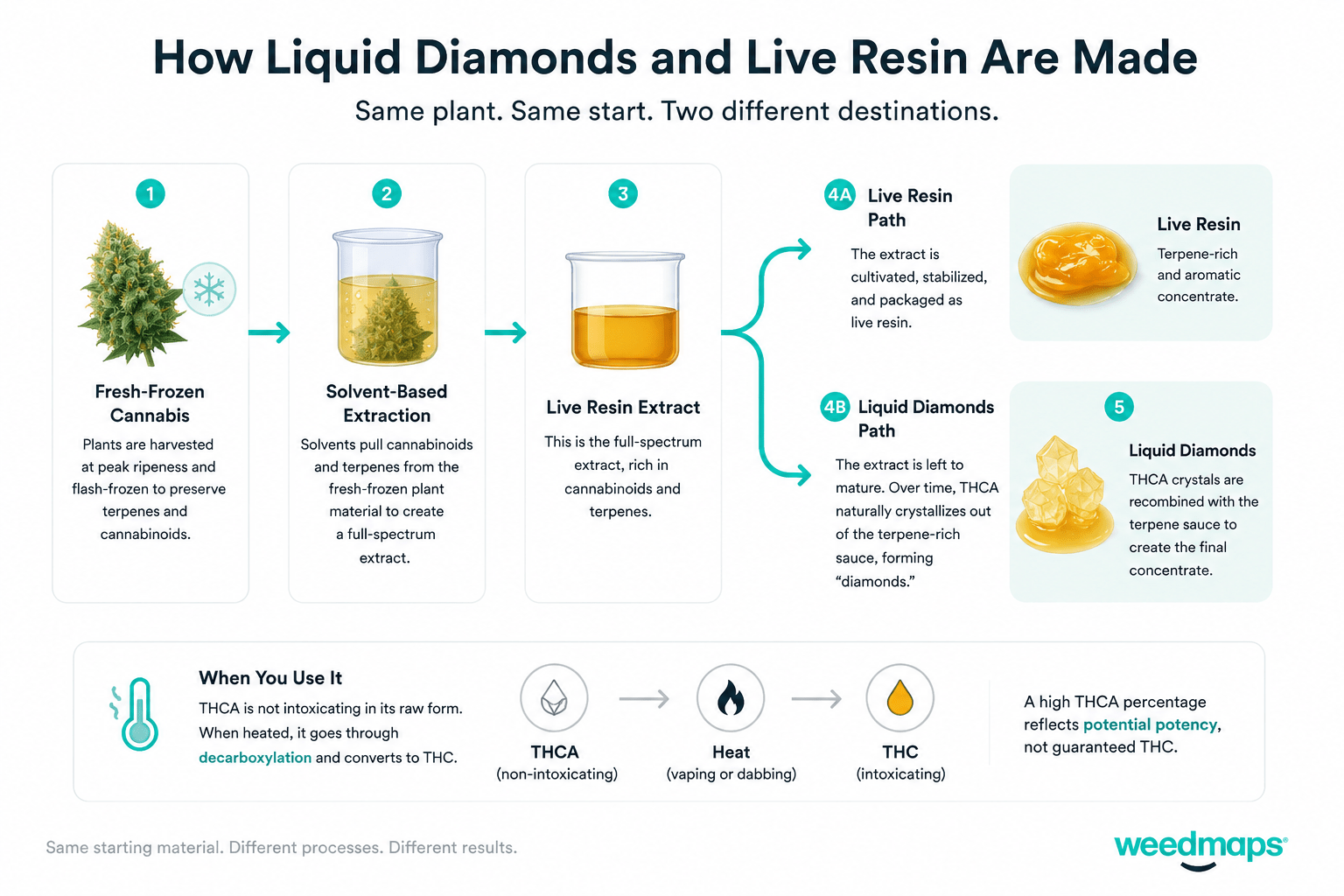
Image lightbox

One more important distinction is what happens when you use either concentrate. The THCA found in some liquid diamonds is not intoxicating in its raw form. It becomes THC through decarboxylation, which may occur during manufacturing or when cannabis is heated during vaping or dabbing. That's one reason a high THCA percentage doesn't always tell the whole story. We'll take a closer look at potency and what those numbers actually mean in the next section.
Image lightbox

Liquid diamonds vs live resin: the key differences
Now that you know how each concentrate is made, it's easier to understand where they differ. Although liquid diamonds and live resin start with the same fresh-frozen cannabis, the extra step of isolating and processing THCA crystals creates noticeable differences in potency, terpene content, texture, and price.
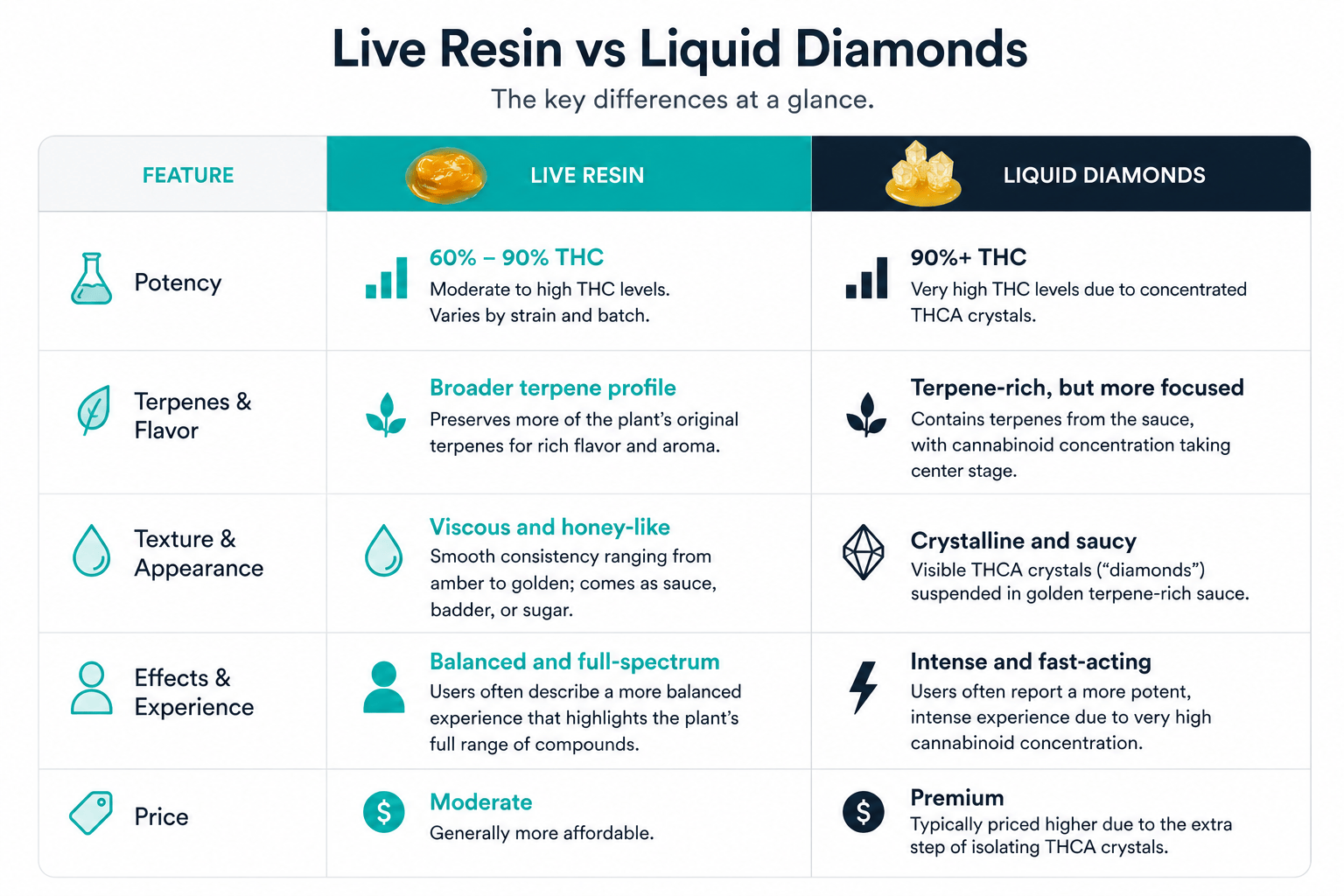
Image lightbox

Potency
Liquid diamonds typically test higher in total cannabinoids than live resin, with some products approaching or exceeding 90% total cannabinoids, while live resin commonly falls within the 60% to 90% range.
A high THCA percentage represents potential potency, not necessarily the amount of THC your body ultimately receives. THCA becomes intoxicating THC only after decarboxylation, the process that occurs when cannabis is heated. Even then, not all THCA converts into THC. In other words, a higher THCA or total cannabinoid percentage on the label doesn't automatically translate to a proportionally stronger overall experience.
Terpenes and flavor
Live resin is generally prized for preserving more of the plant's original terpene profile. Liquid diamonds also contain terpenes, but because the process emphasizes isolating and concentrating THCA before recombining it with terpene-rich sauce, the cannabinoid concentration often takes center stage.
Researchers continue to study the entourage effect, the idea that cannabinoids and terpenes may work together to influence the overall cannabis experience. While the science is still evolving, University of Arizona researchers found that certain cannabis terpenes may contribute their own biological activity, adding to growing interest in how these compounds interact beyond simply providing aroma and flavor.
Texture and appearance
The visual difference between these concentrates is often easy to spot. Live resin can range from a smooth, viscous extract to a granular or whipped consistency, with colors ranging from amber to golden. Depending on the product, it may appear as a sauce, badder, or sugar.
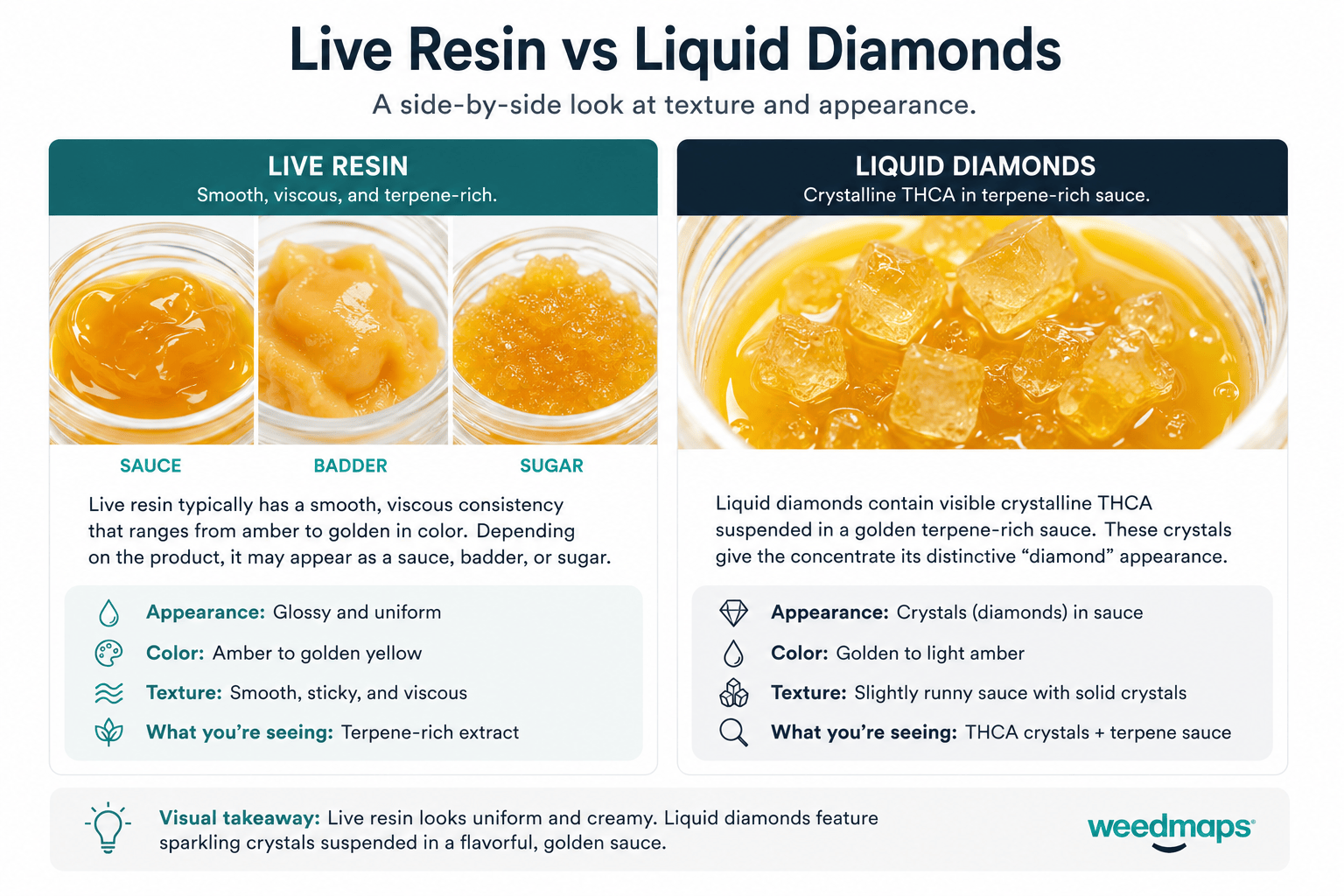
Image lightbox

Liquid diamonds, by comparison, usually appear as a smooth, clear-to-golden oil after the crystalline cannabinoids have been melted or dissolved into the terpene-rich sauce. Products with visible THCA crystals suspended in sauce are more accurately described as diamonds and sauce.
Effects and experience
Potency isn't always the deciding factor. Users often report that liquid diamonds deliver a more intensely potent experience because of their high cannabinoid concentration. By comparison, many consumers describe live resin as offering a more balanced, full-spectrum experience that emphasizes the plant's broader cannabinoid and terpene profile. Individual experiences vary based on factors like tolerance, product formulation, and consumption method.
Price
Liquid diamonds are often priced at a premium compared with live resin because producing purified THCA crystals adds another step to the manufacturing process. That doesn't necessarily make them the better value. For some consumers, the richer terpene profile of live resin is worth prioritizing over higher cannabinoid percentages, while others prefer the potency that liquid diamonds are known for.
Which one is right for you?
The better choice depends on what you want from the experience, how much tolerance you have, and which format you plan to use. Neither concentrate is automatically better. They simply prioritize different things.
Choose live resin if you...
Choose live resin if flavor, aroma, and a fuller terpene profile matter more to you than chasing the highest THC percentage. Many consumers describe live resin as offering a more balanced, full-spectrum experience, though individual results vary.
It may also be the more approachable option if you're newer to concentrates. Live resin can still be highly potent, but it often gives shoppers more room to focus on strain character, terpene profile, and overall experience rather than cannabinoid concentration alone.
Choose liquid diamonds if you...
Choose liquid diamonds if maximum potency is your priority and you already have experience with high-THC concentrates. Users often describe liquid diamonds as more intense and fast acting, largely because these products center on highly concentrated THCA.
They can also be a practical fit for vape shoppers. Their pourable consistency tends to move well through 510 cartridges, while some live resin oils can be thicker and may require hardware designed to handle that viscosity.
Whichever option you choose, potency deserves respect. Research on high-potency concentrates has found an association with greater potential for cannabis-related harms, and broader research has raised similar concerns about frequent use of high-THC products. That doesn't mean every consumer will have the same experience, but it does support a simple approach: start low and go slow, especially if you're new to concentrates or trying a product with a much higher THC level than you're used to.
How to shop for liquid diamonds and live resin
Whether you're shopping online or browsing a dispensary menu, it's worth looking beyond the largest THC number on the label. Start by checking the THC and THCA percentages, then look for the terpene profile if it's available. A certificate of analysis (COA) can also tell you how the product tested for potency and whether it passed screening for contaminants.
Remember that a high THCA percentage reflects potential potency, not necessarily the amount of THC you'll consume. THCA becomes THC only after it's heated through decarboxylation, and not all of it converts during that process. Reading the entire label gives you a more complete picture than focusing on a single percentage.
You'll also notice products labeled as either hemp-derived or marijuana-derived. That distinction can affect what's legally available depending on where you live, so it's worth checking your state's cannabis laws before you shop.
Once you know what you're looking for, compare products by their cannabinoid content, terpene profile, extraction method, and lab results instead of THC percentage alone. Then, browse products from licensed retailers and find dispensaries near you to see what's available in your area.
Frequently asked questions
What hits more, liquid diamonds or live resin?
Liquid diamonds typically test higher in THC, so users often report a more intense experience. However, terpene content and how much THCA converts to THC when it's heated both influence how a product ultimately feels.
Is liquid diamond just THCA?
Not exactly. Liquid diamonds combine THCA crystals with a terpene-rich sauce, so they offer highly concentrated THCA alongside the plant's naturally occurring terpenes.
Are liquid diamonds live resin?
They're closely related, but they're not the same thing. Liquid diamonds are typically made from live-resin-style extract, making them a more concentrated version of the same starting material rather than a separate type of concentrate.
What do liquid diamonds taste like?
Their flavor comes from the terpene-rich sauce surrounding the THCA crystals. Depending on the strain, they often retain distinctive cannabis aromas and flavors that reflect the plant they were made from.
Which lasts longer in a cart, live resin or liquid diamonds?
It depends on both the hardware and how often you use it. Liquid diamonds have a thinner consistency that tends to flow more consistently through standard 510 cartridges, while live resin oils can be thicker and may perform best in hardware designed for more viscous extracts.
Do liquid diamonds have terpenes?
Yes. The THCA crystals are suspended in a terpene-rich sauce, which gives liquid diamonds much of their flavor and aroma while complementing their high cannabinoid content.