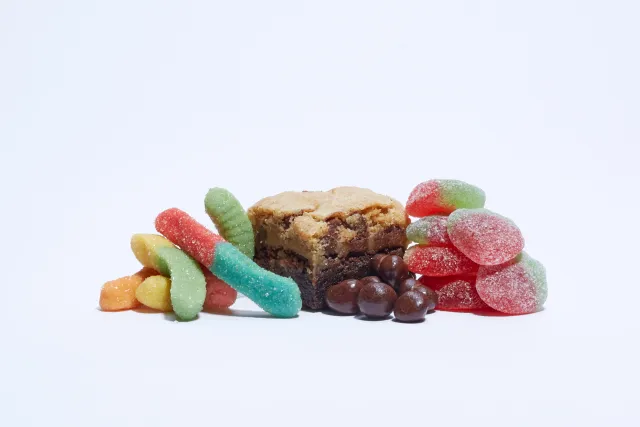
The number on an edible label looks exact. A gummy says 5mg THC. A chocolate square says 10mg THC. A drink says 2.5mg per serving. It feels like clean math.
 Photo by: Gina Coleman/Weedmaps
Image lightbox

But edible dose accuracy is harder to calculate than the label suggests. The printed number is a target based on testing, manufacturing controls, and regulatory tolerance. It is not a promise that every bite will land in your body the same way every time.
That is because two systems are working at once. First, the edible has to be made evenly. Then your body has to absorb and process it.
A good label matters. So does the product format, the brand's manufacturing process, your last meal, your tolerance, and the time you wait before taking more.
The milligram number starts the conversation, but it doesn't finish it.
Why edible labels aren't exact

Image lightbox

A milligram number looks precise, but several steps stand between the label and your experience. Testing, manufacturing, and product design all influence how closely an edible matches the dose printed on the package.
Labels reflect batches, not individual pieces
Edible labels tell you the intended amount of THC or CBD in each serving. They're an essential guide, but they're not a guarantee that every piece contains the exact printed dose.
In regulated markets, edibles are tested for potency through batch sampling. Laboratories don't analyze every gummy, chocolate, mint, or beverage individually. Instead, they test representative samples from a production batch, and those results support the potency listed on the label.
As a result, the label reflects the target formulation and the tested batch. It does not reflect the precise cannabinoid content of every individual serving.
Batch testing is a quality control tool, not a bite-by-bite guarantee. If a representative sample falls within the required potency range and passes the required safety tests, the batch can move forward. That process helps confirm the product is close to what the label claims, but it does not prove every piece is identical.
Even with careful manufacturing, some variation between servings is inevitable. Regulators recognize that milligram-perfect consistency isn't realistic in large-scale food production, so most legal markets allow an acceptable potency range.
That means a gummy labeled 10mg THC won't always contain exactly 10mg. As long as it falls within the allowed tolerance, it is considered compliant. Those small differences matter most at lower doses, where a one- or two-milligram swing represents a much larger percentage of a 2.5mg or 5mg edible than it does a 25mg serving.
Manufacturing determines consistency
Testing is only part of the story. The consistency of an edible also depends on how well it is made.
THC is fat-soluble, which means it mixes more easily with oils and fats than with water-based ingredients. Many edible recipes contain water, sugar, gelatin, pectin, chocolate, butter, or other ingredients that do not all hold cannabinoids the same way.
If the infused oil is not blended evenly, cannabinoids can concentrate in some areas and be lighter in others. That creates "hot spots" and "low spots" within the same batch. In a gummy, one piece may contain slightly more THC than another. In a brownie, one corner may not match another. In chocolate, the cannabinoid infusion has to remain evenly distributed throughout the fat phase as the product cools and sets.
This is where homogenization becomes important. Homogenization is the process of thoroughly mixing cannabis extract into the edible base before the product is portioned. The goal is to keep cannabinoids evenly distributed throughout the mixture so each serving pulls from the same well-mixed batch instead of from concentrated pockets. When the process is done well, each serving is much more likely to deliver a consistent dose.
This is one reason gummies are often more consistent than baked goods. Gummies are typically made from a controlled liquid base that can be mixed before it sets, and each mold receives a measured amount from that batch.
Baked goods are more difficult to standardize because batter density, fat content, mixing time, oven heat, and portioning can all influence consistency. Chocolate presents its own challenges because cannabinoids are carried through the fat phase.
None of this means gummies are automatically perfect or baked edibles are automatically unreliable. It means the product format and the manufacturing process both influence dose consistency. That's why manufacturing quality matters just as much as laboratory testing when it comes to delivering a consistent edible. A good edible should make the dose easy to understand and the serving easy to repeat.
Why the same edible can feel different every time

Image lightbox

A 10mg edible tells you how much THC went into the product. It can't predict exactly how your body will respond. Once you consume an edible, digestion, metabolism, and food intake all influence how quickly THC takes effect, how strongly you feel it, and how long the experience lasts.
After you swallow THC, it passes through the digestive system before reaching the liver, where much of it is converted into 11-hydroxy-THC. This metabolite is one reason edibles often feel stronger and last longer than inhaled cannabis. Beyond that, differences in metabolism, tolerance, and stomach contents mean the same edible can feel different from one person to another, or even from one day to the next.
Food adds another layer of variability. A large meal can delay digestion, while a high-fat meal may increase cannabinoid absorption because THC is fat-soluble. The label hasn't changed. The conditions affecting absorption have.
That variability also explains why patience matters. Edibles may take 30 minutes or well over an hour to become noticeable, and peak effects can take even longer. Taking another serving before the first has fully developed can make it difficult to judge how the original dose actually affected you. Waiting gives you a clearer picture of how a product behaves before deciding whether to take more.
How to choose more consistent edibles

Image lightbox

No edible can guarantee the exact same experience every time, but some products are designed to make dosing easier than others. If consistency is important to you, pay attention to more than just the THC number on the label.
Look for products that:
- Have clearly defined serving sizes
- Come from licensed manufacturers in regulated markets
- Make it easy to repeat the same dose from one serving to the next
Formats such as gummies, mints, tablets, and scored chocolate bars are often easier to portion consistently than products you have to divide yourself. Licensed products also undergo potency testing and are manufactured to meet regulatory standards, which can improve consistency from batch to batch.
Finally, think about the serving size, not just the total THC in the package. Products with 2.5mg or 5mg per serving give you more flexibility than products with 25mg in a single piece, making it easier to adjust your dose gradually and repeat an experience that works for you.
The bottom line

Edible labels provide a reliable starting point, but manufacturing quality, testing standards, and your own biology all influence how an edible performs after you consume it. Understanding those variables can help you set realistic expectations, choose products more confidently, and build a dosing routine that works for you.
Ready to put that knowledge to use? Explore edibles on Weedmaps to compare products, browse licensed dispensary menus, and find options with serving sizes and doses that match your experience level.