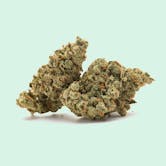
Mangolicious
Mangolicious puts ripe mango in the grinder, but the name comes with two different family trees.
Origin 1: The commonly described version pairs Big Bud with White Widow. Its original breeder remains unconfirmed. This is the mango-and-pineapple combination associated with substantial flowers, generous frost, and an upbeat opening that can settle into much deeper relaxation.
Origin 2: Amsterdam Marijuana Seeds developed its Mangolicious through four years of selection, naming Light of Jah, Super Skunk, and Asian Big Bud in the pedigree. AMS emphasizes rich mango flavor, large flowers, and relaxing effects with an uplifting side.
For the classic version, sweet mango takes the lead, pineapple adds a sharper tropical edge, and dank earth keeps the whole thing rooted in weed. There’s a little herbal character beneath the fruit, too. Think ripe produce with the soil still on its shoes. Described flowers are forest green and sticky, with a fluffy structure, fine orange pistils, and a thick layer of amber-toned frost.
Community reviews say the effects land cheerful, floaty headspace with physical relaxation, but the landing varies. Some smokers stay engaged and creative; one describes getting happily absorbed in a long guitar session. Others report heavy eyelids and a much sleepier finish. Mangolicious can supply the tropical mood without supplying the motivation to leave the house. Put on the album, settle into the session, and let the mango do the talking.
AMS offers its feminized photoperiod version for indoor and outdoor cultivation. The breeder gives a broad flowering window of six to ten weeks, heights of approximately 90–220 cm depending on the environment, and estimated yields of 550–800 g/m². Those are breeder figures for the AMS offering, not guarantees for every plant carrying the name.
For the Big Bud × White Widow version, descriptions consistently emphasize substantial flowers and generous production, but a confirmed breeder schedule and measured yield remain unavailable. Its cultivation figures should not be borrowed from the separate AMS line. Likewise, an autoflower sold under the name needs its own life-cycle specifications rather than the photoperiod flowering window.