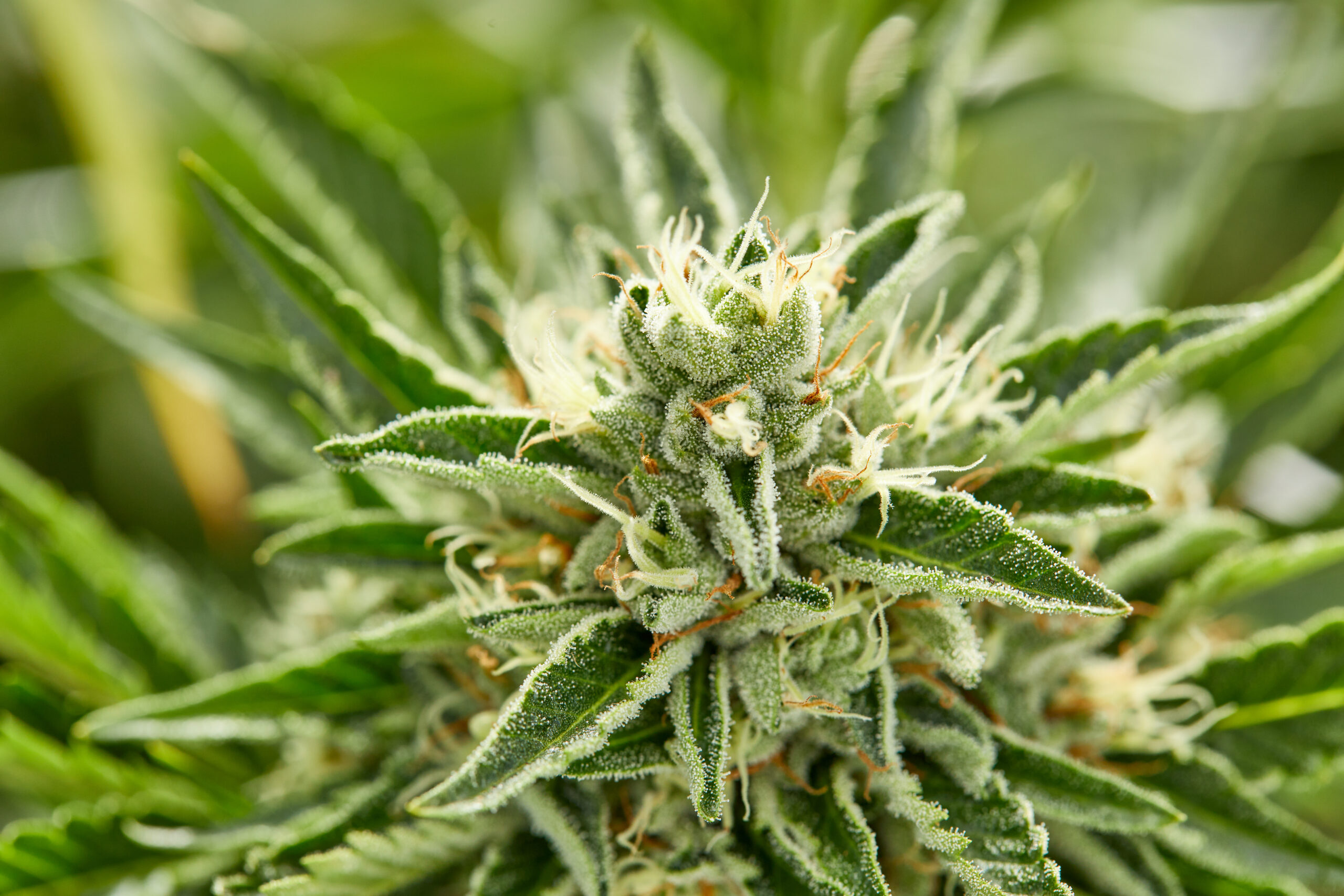
No specific weed strain can guarantee fewer munchies. THC is the cannabinoid most clearly associated with increased appetite, while THCV and CBD are being studied for different effects on hunger. Checking the cannabinoid panel for the specific batch is more reliable than choosing by strain name or indica/sativa label.
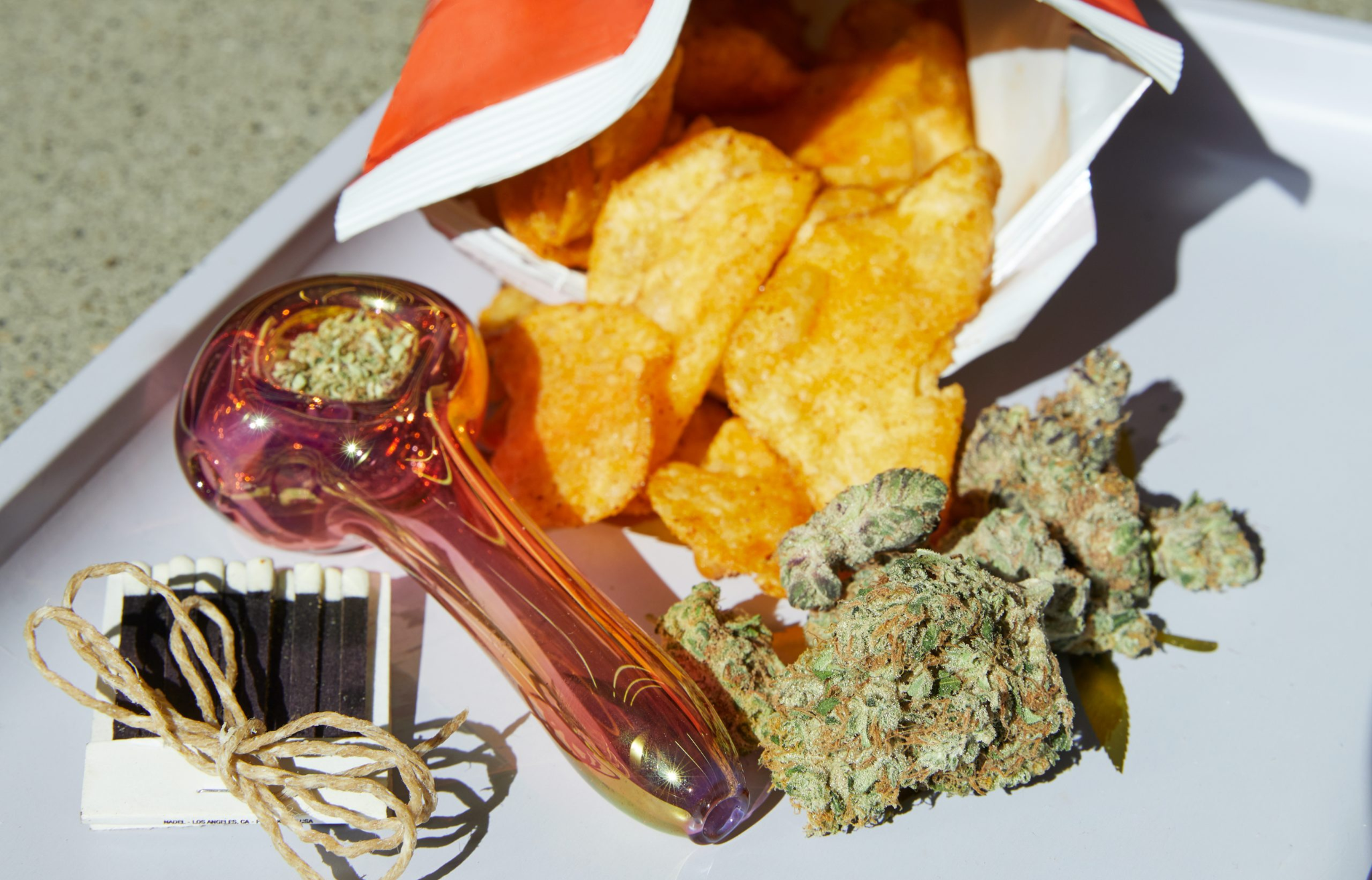 Photo by: Gina Coleman/Weedmaps
Image lightbox

No specific weed strain can guarantee fewer munchies. THC is the cannabinoid most clearly associated with increased appetite, while THCV and CBD are being studied for different effects on hunger. Checking the cannabinoid panel for the specific batch is more reliable than choosing by strain name or indica/sativa label.
Why some weed gives you the munchies (and some doesn't)
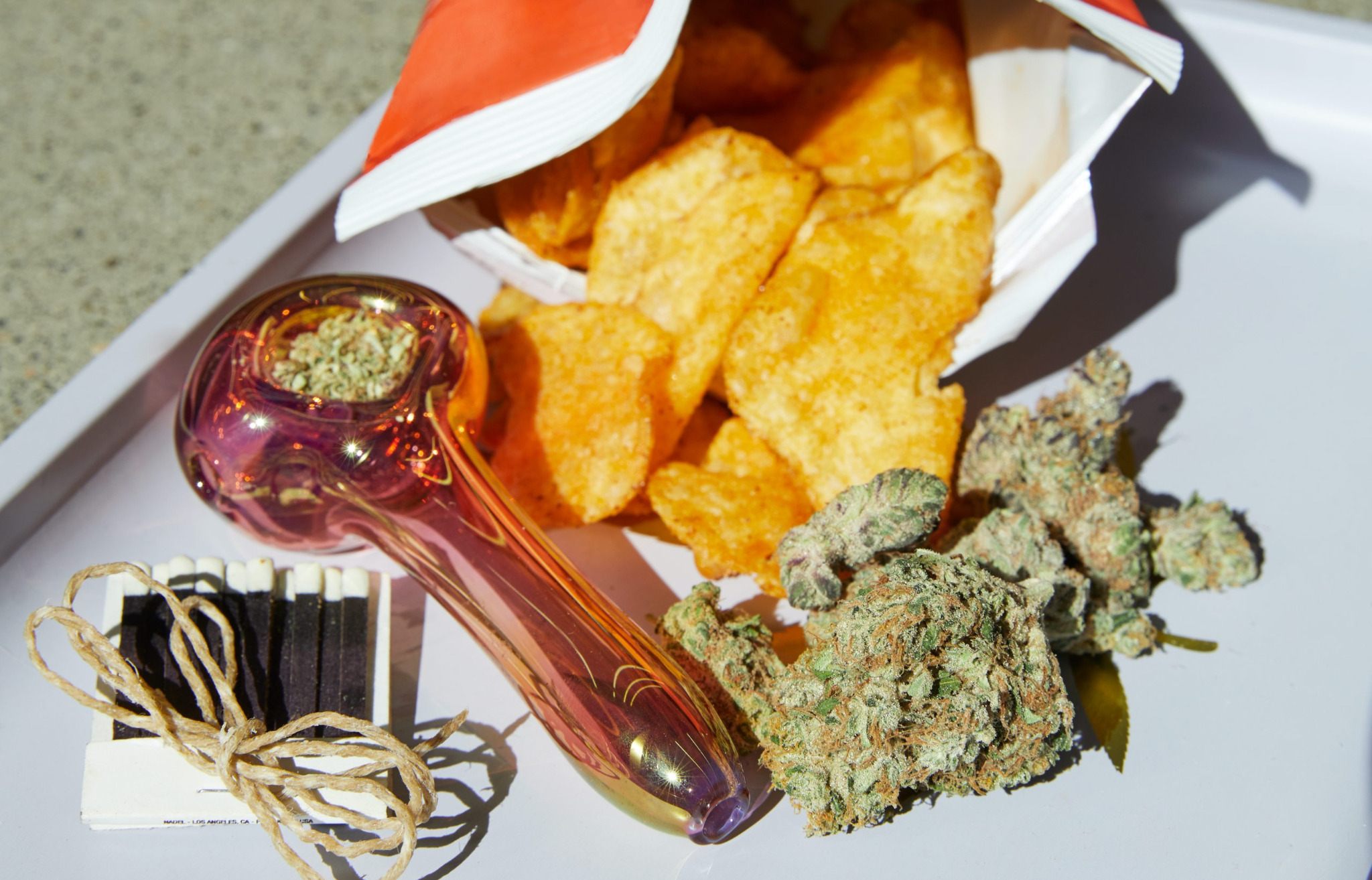
The munchies aren't just a cannabis cliché. Researchers have linked THC's effects on appetite to the endocannabinoid system, which helps regulate hunger, energy balance, and the motivation to eat.
According to research on cannabinoids and appetite, THC activates CB1 receptors in the hypothalamus, the part of the brain that helps regulate hunger and energy balance. When those receptors are activated, food can become much more tempting, even if you weren't especially hungry to begin with.
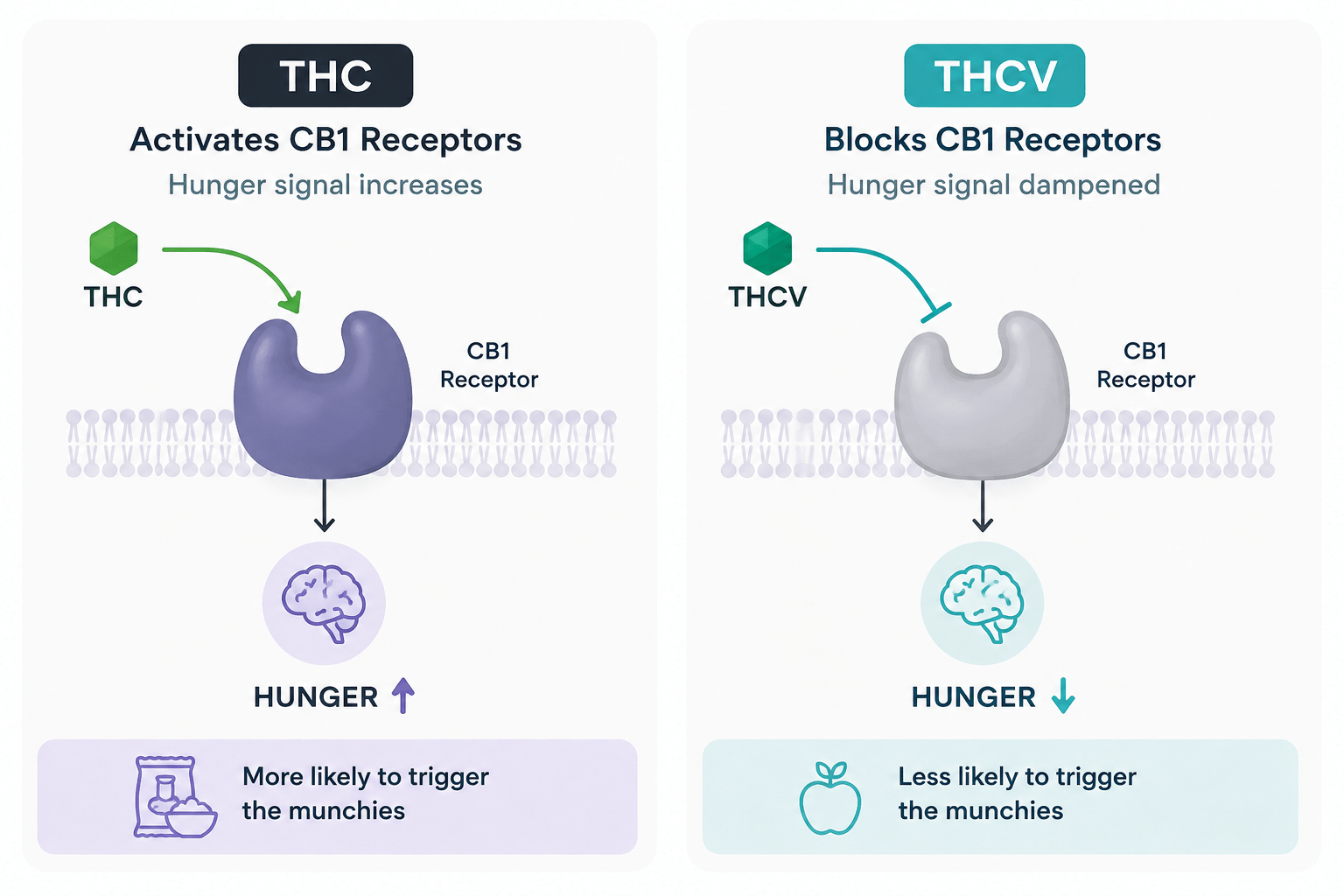
Image lightbox

THC also appears to influence the hormones involved in appetite. In a study on THC and appetite hormones, cannabis use was associated with higher levels of ghrelin, often called the "hunger hormone" because it signals that it's time to eat. Researchers found that greater THC exposure was linked to larger increases in ghrelin.
Not every cannabis product affects appetite the same way. Different products contain different combinations of cannabinoids and terpenes, and that mix shapes the overall experience. THC is the cannabinoid most clearly associated with increased hunger. THCV and CBD interact with the endocannabinoid system differently, although neither has been proven to prevent the munchies. The strain name or an indica/sativa label only tells part of that story. The cannabinoid profile of the specific product tells you more.
Which cannabinoids influence hunger
THCV has attracted the most attention as a possible counterpoint to THC. According to a review of THCV research, THCV interacts with CB1 receptors differently than THC does. At lower concentrations, it can act as a CB1 antagonist, interfering with some CB1 activity instead of activating the receptor in the same way as THC. Its behavior changes with dose, and researchers haven't established how reliably those laboratory mechanisms affect hunger in people.
Preclinical research has connected THCV with changes in glucose regulation and energy expenditure, but the findings are more complicated than the "diet weed" nickname suggests. Research in mice found that THCV improved some measures of glucose regulation and temporarily increased energy expenditure. It did not significantly reduce food intake or body-weight gain. Animal findings don't necessarily translate to people.
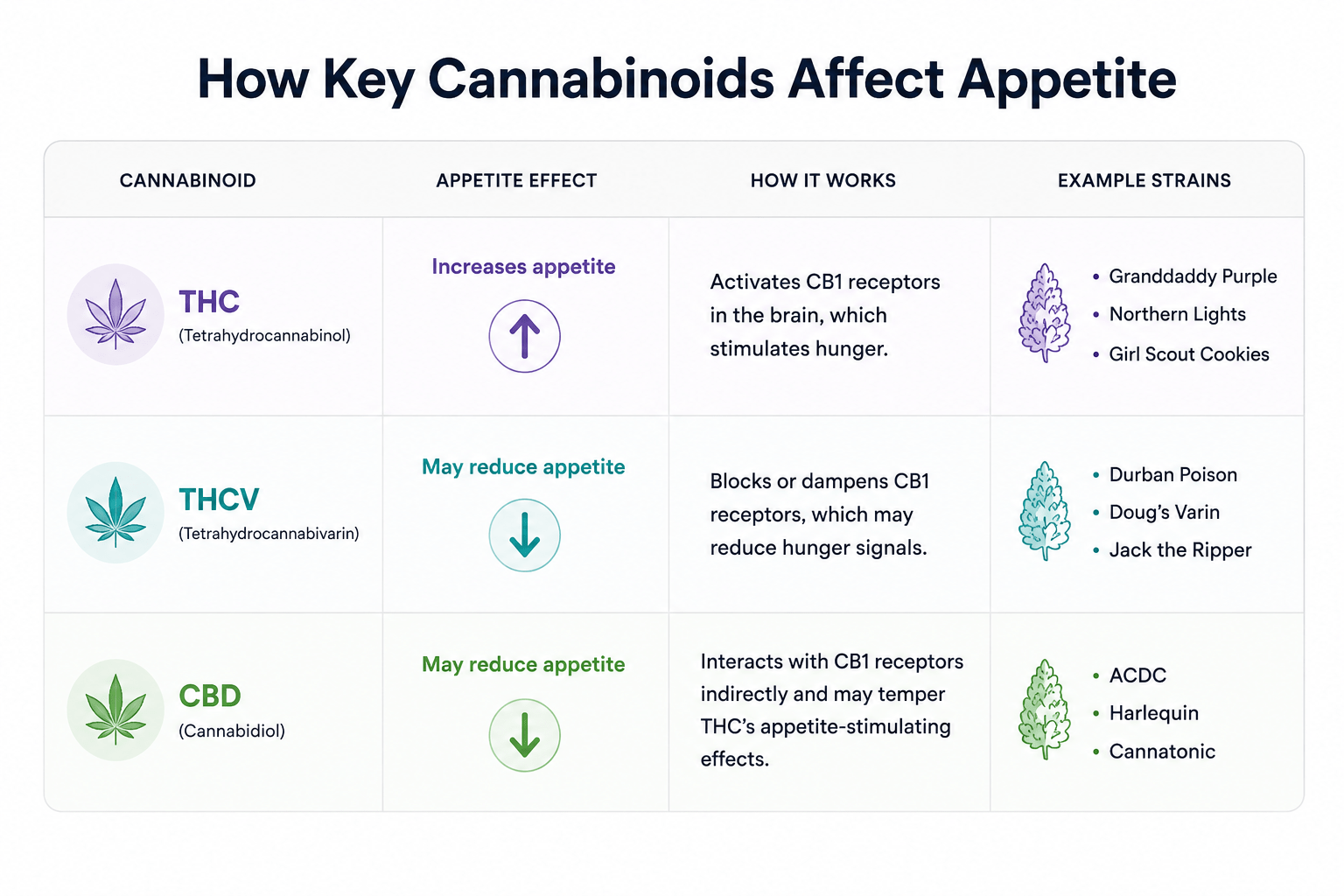
Image lightbox

CBD has attracted attention for different reasons. A systematic review of CBD and appetite found that a majority of the included clinical trials associated CBD with reduced appetite or body weight, with stronger effects among some participants with higher BMI. The evidence was inconsistent, however. Several studies found no significant effect, one reported increased appetite, and most raised concerns about risk of bias.
Separate research on cannabis and weight has examined connections among CBD, appetite, fullness, and body weight. The evidence doesn't establish that CBD counteracts THC-induced hunger or that CBD-rich cannabis prevents the munchies.
Neither cannabinoid offers a guaranteed way to avoid hunger. Human research remains limited, and dose, product composition, and individual biology all affect the experience. When comparing products, the cannabinoid panel is more informative than the strain name alone.
Does humulene really curb the munchies?
If you've spent any time reading about cannabis terpenes, you've probably come across the claim that humulene suppresses appetite. It's an earthy, hoppy terpene found in cannabis, hops, and black pepper, and it shows up often on lists of compounds that supposedly help you avoid the munchies.
The evidence doesn't back that up yet. A scoping review of humulene research examined hundreds of studies and found that humulene has several interesting biological properties, including anti-inflammatory potential, but no clinical evidence showing it suppresses appetite in people. Most of the research so far has been done in the lab or in animal models, not human clinical trials.
That's not the same as saying humulene does nothing. It simply hasn't been proven to suppress appetite, so don't treat its presence on a terpene panel as evidence that a product will prevent the munchies.
Indica vs. sativa: does the label matter?
Most people have heard that sativas are less likely to cause the munchies. It's a common rule of thumb, and not a very reliable one.
Some THCV-rich cannabis varieties trace back to sativa-leaning or equatorial genetics, which explains where the idea comes from. But research on cannabis and weight suggests that the cannabinoid profile provides more useful information about possible appetite effects than an indica or sativa label does.
Two products sold under the same strain name can carry very different cannabinoid profiles depending on their genetics, how they were grown, and the batch being tested. One batch might contain measurable THCV; another might contain almost none.
Skip the label and check the certificate of analysis (COA). It'll tell you more than "indica" or "sativa" ever could. For more on why these labels don't hold up the way people assume, see our guide to indica vs. sativa.
Strains people reach for when they want the high without the hunger
There's no single perfect strain for dodging the munchies. Some cultivars have been selected and tested for elevated THCV, while others are associated with THCV despite limited batch-specific evidence.
Doug's Varin and Pink Boost Goddess are two of the better-documented THCV-forward cultivars. Durban Poison, Jack the Ripper, and Red Congolese also appear frequently on lists of THCV-associated strains, but those names don't guarantee that a particular product contains a meaningful amount. Reviewers often describe these cultivars as uplifting, energizing, and clear-headed.
For CBD, ACDC, Harlequin, Cannatonic, Ringo's Gift, Sour Tsunami, Pennywise, and Charlotte's Web are among the best known. Depending on the grower and batch, they can contain more CBD and less THC than conventional THC-dominant flower, and reviewers often describe them as offering a gentler experience. CBD content doesn't guarantee that a product will prevent the munchies.
Cannabinoid levels shift from grower to grower and batch to batch. Check the COA whenever it's available instead of assuming every product sold under a familiar strain name has the same chemistry.
Consumption method changes the equation
The way you consume cannabis changes how quickly its effects begin and how long they last, but research hasn't established that one method reliably produces fewer munchies than another.
In a human study on cannabis and metabolism, 20 participants received oral, smoked, or vaporized cannabis in separate sessions. Total ghrelin levels during the oral cannabis session were higher than during the smoked and vaporized sessions. However, the researchers measured hormone levels, not hunger, food intake, or the intensity and duration of the munchies. The study therefore doesn't establish that edibles produce a stronger appetite response.
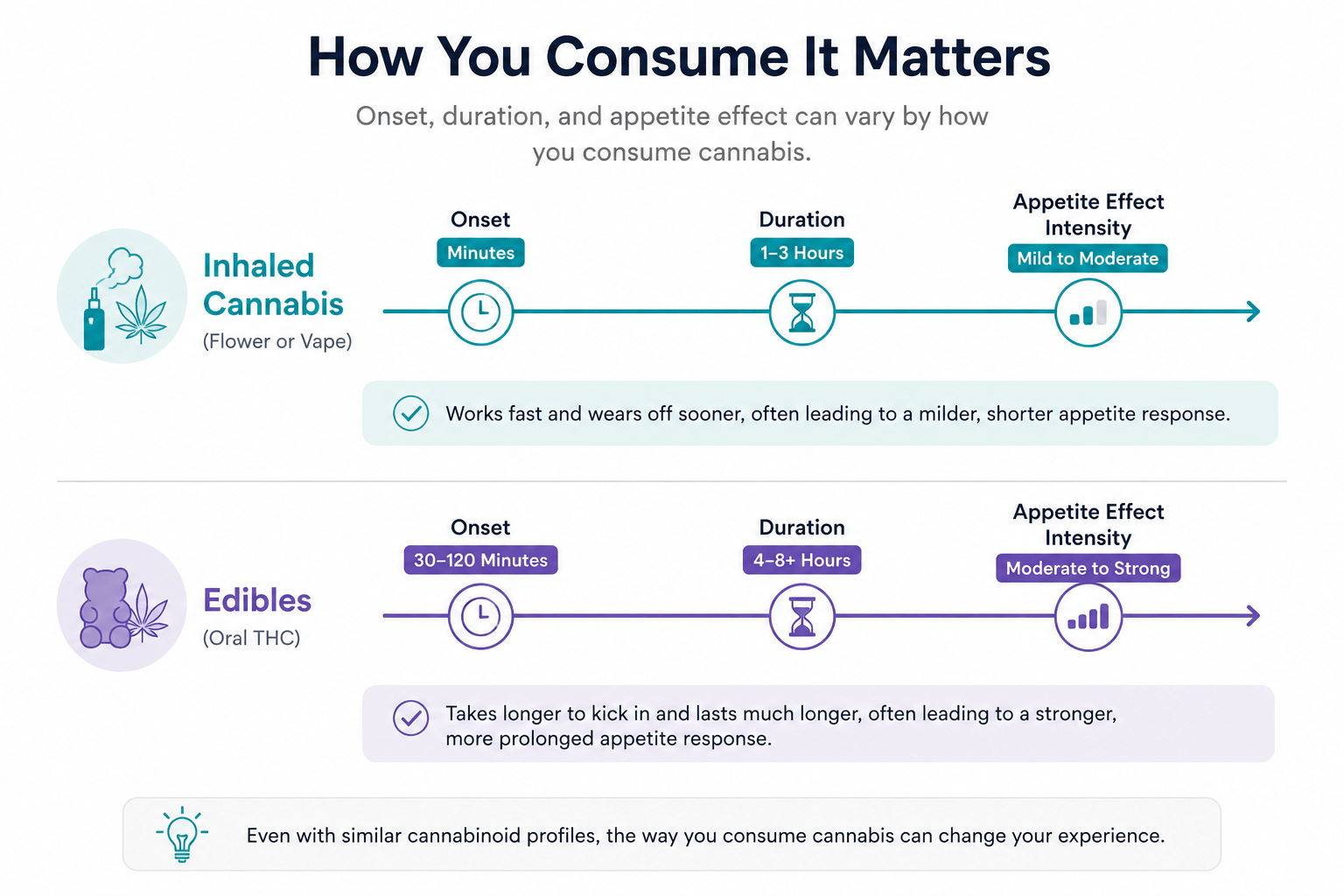
Image lightbox

Edibles generally take longer to kick in and last much longer. Inhaled cannabis, including flower and vapes, works faster and typically wears off sooner. Two products with a near-identical cannabinoid profile can still feel different depending on whether you eat or inhale them. If you'd like to compare formats directly, our guides to edibles and vapesbreak down what to expect from each.
How to actually find a low-munchie product
Finding a cannabis product that's less likely to trigger the munchies starts with looking past the strain name. High-THCV flower exists, but it's uncommon because THCV naturally occurs in small amounts.
Start with the certificate of analysis (COA). Look for measurable THCV, CBD, and overall THC content instead of relying on marketing or a familiar strain name. Not every standard cannabis test reports minor cannabinoids such as THCV, so its absence from a label or menu doesn't confirm that none is present.
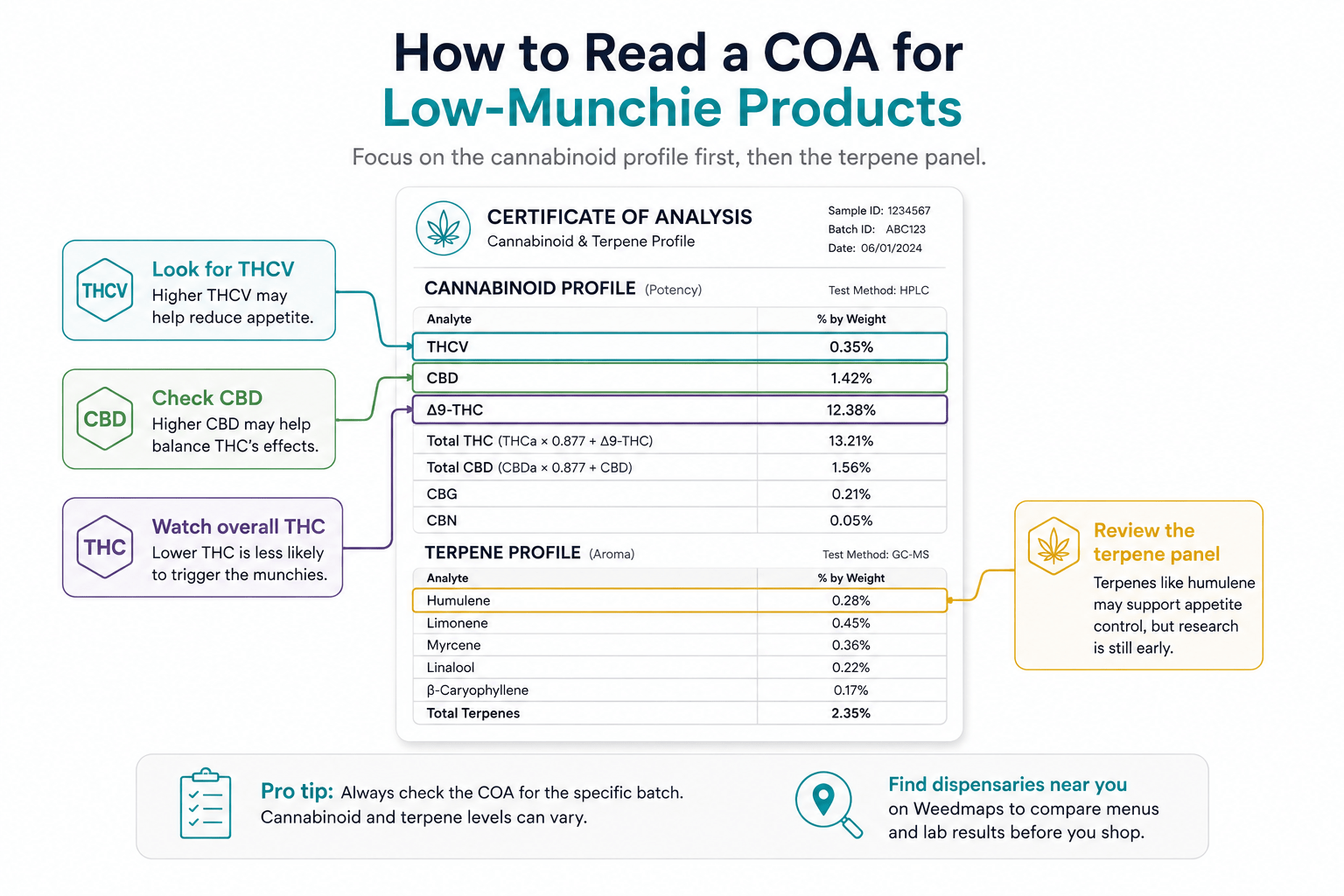
Image lightbox

The terpene panel adds context about a product's aroma and chemical composition, but there isn't enough human evidence to use terpenes as reliable predictors of appetite.
When shopping in person, ask your budtender whether they carry products that test higher in THCV or CBD and whether lab results are available for that specific batch. When shopping online, compare the cannabinoid data on the menu before deciding.
You can find dispensaries near you on Weedmaps and compare local menus, product details, and cannabinoid information before you head out.
Set realistic expectations
There's no cannabis product that guarantees you won't get hungry, and what works for one person won't necessarily work the same way for someone else.
Dose, cannabinoid profile, metabolism, previous experience with cannabis, and what you've eaten that day all play a role.
Cannabis isn't a weight-loss tool, either. Finding a product that doesn't leave you hungry isn't the same as finding a product that causes weight loss. Research into THCV, CBD, appetite, and metabolism hasn't established cannabis as a safe or reliable weight-management strategy.
Frequently asked questions
Is sativa or indica better for appetite suppressant?
Neither. Those categories don't tell you how much THC, CBD, or THCV a particular batch contains. Check the cannabinoid panel instead.
Which strain gives you the least munchies?
There isn't one definitive answer. Strains reported to run higher in THCV or higher in CBD and lower in THC are the ones most commonly associated with a lower likelihood of triggering the munchies, but it's always worth checking the certificate of analysis (COA) to see what's actually in the product.
What strains are good for suppressing appetite?
No strain has been clinically proven to suppress appetite. Doug's Varin is known for THCV-forward selections, while Durban Poison is commonly associated with THCV but requires batch testing. CBD-forward options include ACDC and Harlequin, although CBD doesn't guarantee fewer munchies.
Is there a cannabinoid that suppresses appetite?
THCV is the cannabinoid most often studied for possible appetite-suppressing effects, but human evidence remains limited and its activity changes with dose.
Does humulene really suppress appetite?
Not based on the evidence available today. Humulene is often promoted online as an appetite-suppressing terpene, but there isn't solid clinical evidence showing it has that effect in people.
Do edibles make you hungry?
THC can increase hunger whether it is eaten or inhaled. One small study found higher total ghrelin after oral cannabis than after smoked or vaporized cannabis, but it did not measure hunger or food intake. Current evidence doesn't establish that edibles cause stronger munchies.
The bottom line
If you're trying to avoid the munchies, don't put too much stock in the strain name alone. Looking at the cannabinoid profile, checking the certificate of analysis (COA), and thinking about how you plan to consume cannabis will give you a much better idea of what to expect than simply choosing an indica or a sativa.
Whether you're curious about THCV, CBD, or just want to compare products with more confidence, explore more on Weedmaps to learn about strains, cannabinoids, and cannabis education.
When you're ready to shop, find dispensaries near you to browse local menus and compare products before you buy.