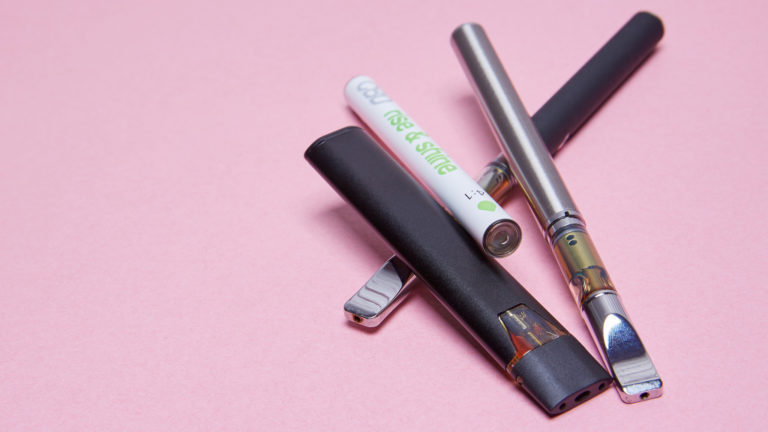
Weed pens don't expire on one universal schedule, but their oil and hardware can deteriorate with age. Check the manufacture or expiration date and replace a cart if the oil changes unexpectedly, the cartridge leaks or appears damaged, or the vapor tastes burnt, metallic, or unusually harsh. Store carts upright in a cool, dark place and follow the manufacturer's instructions.
 Photo by: Gina Coleman/Weedmaps
Image lightbox

Finding an old vape cart in a drawer raises an obvious question: do weed pens expire? The short answer is yes. While most THC vape cartridges maintain their best quality for about 6–12 months when stored properly, both the cannabis oil and the hardware gradually break down over time.
That doesn't mean an older cart suddenly becomes unusable the day it reaches its printed expiration date. In most cases, expiration is a quality benchmark rather than a hard cutoff. The oil may lose flavor, potency, and aroma, while the cartridge itself may develop mechanical issues such as clogging or poor vapor production.
In this guide, we'll explain how long weed pens last, how to spot signs of degradation, what happens if you use an expired cart, and the best ways to extend the life of your cannabis vape.
Do weed pens expire?
Yes: weed pens expire. Both the cannabis oil inside the cartridge and the hardware used to vaporize it gradually degrade over time.
Research and industry data suggest that most THC vape cartridges maintain optimal quality for approximately 6–12 months when stored correctly. Some unopened cartridges may remain usable for 18–24 months, but users often report noticeable declines in flavor, aroma, and potency as they age.
Part of that decline comes from the natural chemistry of cannabis. THC (delta-9-tetrahydrocannabinol) gradually oxidizes over time, with cannabinoid degradation occurring at rates that may approach roughly 5% per month at room temperature under unfavorable conditions. Storage conditions such as heat, oxygen exposure, and light can accelerate the process.
It's also important to understand what an expiration date actually means. For licensed cannabis products, the printed date generally reflects the manufacturer's quality standard rather than a sudden safety deadline. A cart doesn't instantly become bad overnight.
There are really two separate expiration processes happening at once:
- Oil degradation: a chemical process affecting cannabinoids, terpenes, flavor, and potency.
- Hardware degradation: a mechanical process affecting the cartridge, atomizer, coil, seals, and airflow system.
Understanding the difference helps explain why one cart may still produce vapor but taste stale, while another may contain quality oil but fail because the hardware stopped functioning properly.
Does flavor or potency degrade first?
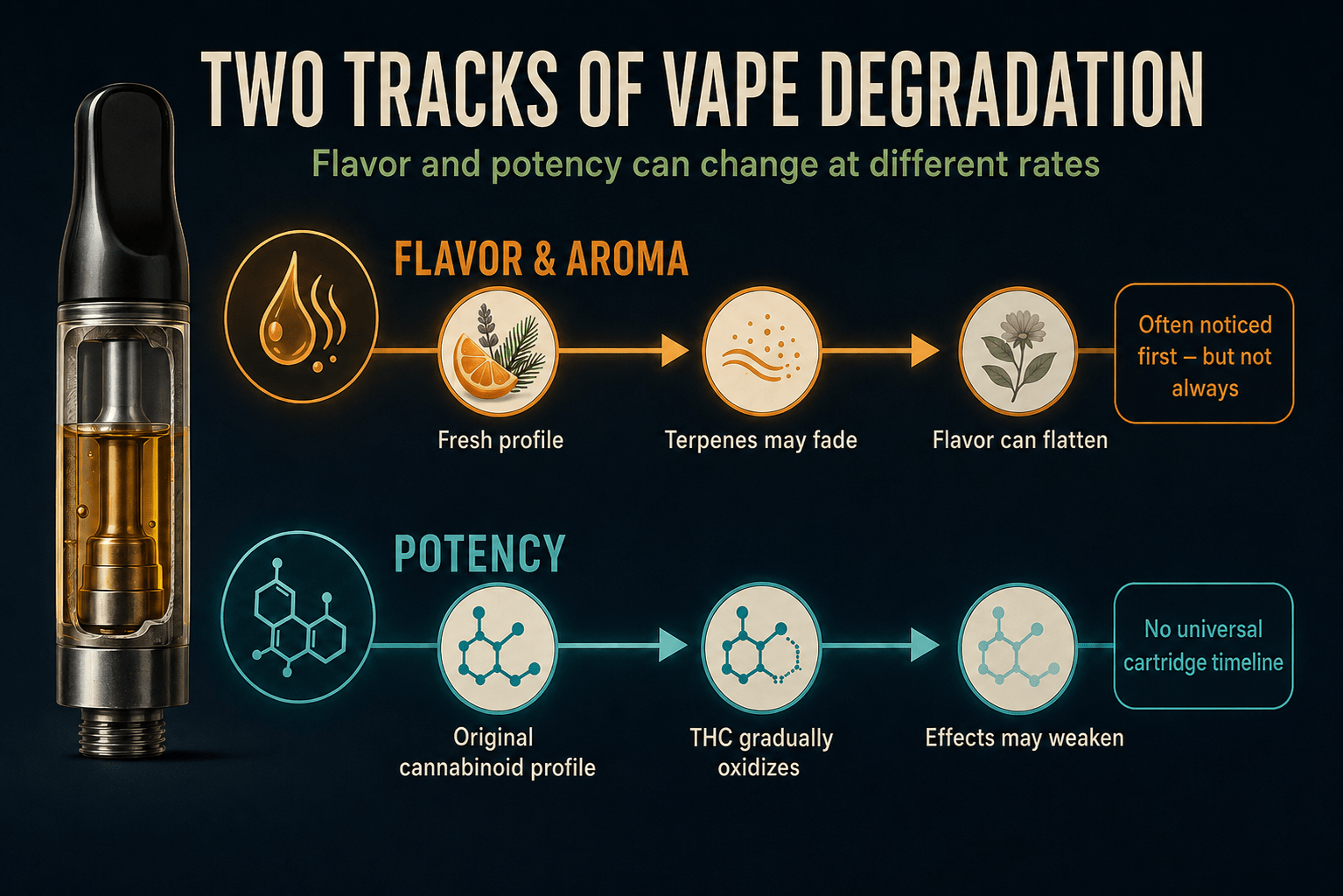
Image lightbox

Flavor and potency don't disappear at the same rate.
In many cases, users notice flavor changes long before they notice meaningful potency loss. That's because the compounds responsible for aroma and taste, terpenes are generally less stable than cannabinoids and tend to degrade more quickly under heat and oxygen exposure.
Think of a vape cartridge as having two separate expiration clocks running at the same time.
The first clock affects flavor. As terpenes break down, a cartridge may lose its strain-specific aroma and develop a flatter, less enjoyable taste. A cart that's four to six months old may still produce noticeable effects while tasting significantly less vibrant than it did when fresh.
The second clock affects potency. THC oxidizes gradually into other compounds, including cannabinol (CBN) and smaller amounts of other degradation byproducts. While cannabinoids are relatively stable when stored under controlled conditions, degradation still occurs over time.
Research also suggests that the most significant cannabinoid losses occur during the earliest stages of storage rather than years later. After that initial decline, the degradation curve becomes more gradual.
Another important nuance: heat is a bigger threat than light. Research indicates that thermal degradation contributes more heavily to cannabinoid breakdown than photodegradation in many storage environments.
The practical takeaway? A cartridge can taste noticeably worse while still containing most of its original THC. That's why consumers sometimes describe an older cart as "weak" when the bigger issue is actually terpene loss rather than major potency loss.
Put simply: if your cart tastes stale but still produces effects, you're likely experiencing flavor degradation first and potency degradation second.
How to tell if a cart has expired

Image lightbox

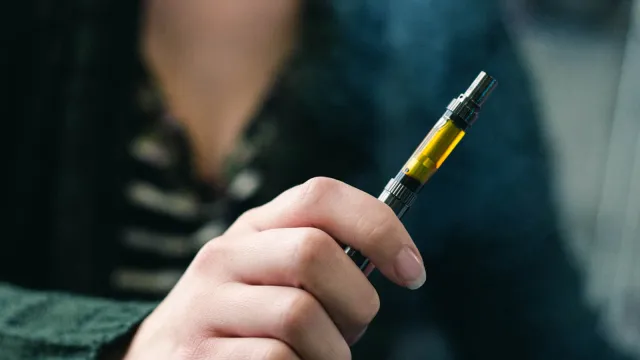
One of the easiest ways to identify an aging vape cartridge is to look at the oil itself. Visual changes provide the earliest clues that degradation is occurring.
Signs the oil may be degrading
Fresh oil
- Light gold or pale amber appearance
- Clear and uniform consistency
- Distinct strain-specific aroma
Moderately aged oil
- Darker amber coloration
- Slightly muted aroma
- Flavor may begin to taste less vibrant
Heavily oxidized oil
- Dark brown appearance
- Noticeably diminished flavor
- Harsher vapor and reduced overall experience
Potential contamination warning
- Cloudy oil
- Black discoloration
- Visible particles that weren't present originally
Terpenes are more volatile than cannabinoids. That's why many consumers notice changes in aroma and flavor before they notice meaningful potency loss.
Think of a vape cartridge as having two separate expiration clocks running at the same time.
One important detail: the dark color isn't actually caused by CBN itself. Research indicates that pure CBN is nearly colorless, while the darkening commonly seen in older cartridges comes from a mixture of oxidative intermediates and other degradation compounds created during the oxidation process.
Sensory signs of an expired cart
Users report several noticeable changes as cartridges age:
- Less pronounced aroma
- Flattened or muted flavor
- Harshness during inhalation
- Reduced vapor production
- Less satisfying overall experience
Pure CBN is nearly colorless and is NOT responsible for the red/brown oil discoloration seen in aged carts.
Hardware problems that aren't oil degradation
A surprising number of "expired" carts are actually suffering from hardware issues rather than degraded oil.
Common signs include:
- Burnt taste from coil wear
- Persistent clogging
- Uneven heating
- Weak vapor production
- No vapor despite a charged battery
This distinction matters because replacing the cartridge hardware can sometimes solve the problem even when the oil itself remains usable.
Research and industry testing also suggest that ceramic coils generally provide more even heating than traditional metal coil systems, which may contribute to better flavor preservation over time.
Before throwing away an older cart, check both the oil and the hardware. A dark cartridge may still function, while a seemingly fresh cartridge may perform poorly because the atomizer has reached the end of its lifespan.
What happens if you smoke an expired cart
If you've found an older cartridge, you're probably wondering whether using it is dangerous.
For products purchased from a licensed dispensary, expiration generally means reduced quality rather than a direct health hazard. Research suggests that expired oil from a licensed product is more likely to result in diminished flavor, reduced potency, and a harsher vaping experience than a specific safety risk from expiration itself. Users report weaker flavor, lower potency, harsher vapor, and a less satisfying overall experience as cartridges age.
The bigger safety conversation involves counterfeit and illicit-market products, not normal aging.
The CDC identified the 2019 EVALI outbreak, and the majority of hospitalized cases were linked to THC-containing vape products. Investigators later identified vitamin E acetate — a cutting agent commonly found in illicit and counterfeit cartridges — as a key contributor to the outbreak. According to reporting highlighted at the 2024 American Thoracic Society conference, EVALI continues to be monitored as an ongoing public-health concern.
Research has also identified another area worth understanding: hardware contamination. A peer-reviewed study published in Nature analyzed metal contamination from cartridge components into cannabis aerosol during vaporization. This doesn't mean every cartridge is dangerous, but it reinforces the importance of purchasing products from reputable, regulated sources.
The practical takeaway is simple:
- Expired licensed cartridges mean lower quality, not immediate danger
- If a cartridge tastes unusually harsh, burnt, metallic, or otherwise off, it's probably not worth using
- Purchasing products from a licensed dispensary near you remains one of the best ways to reduce risk and ensure product quality
Medical disclaimer: This page is for informational purposes only and not intended as medical advice. Please consult your physician before changing any medical treatment.
Live resin vs. distillate — which lasts longer?

Image lightbox

If you're deciding between live resin and distillate cartridges, shelf life probably isn't the first thing that comes to mind. But it can make a difference, especially if you don't vape frequently.
The biggest distinction comes down to terpene content.
Live resin contains approximately 60–85% THC along with significantly higher terpene concentrations, while distillate contains 80–95% THC and minimal terpenes.
Those terpenes are a big reason many consumers prefer live resin's flavor and aroma. They're also why live resin tends to be more sensitive to storage conditions. Higher terpene content makes live resin more susceptible to degradation from heat, light, and oxygen compared to distillate.
In practical terms, live resin and distillate cartridges generally share the same 6–12 month shelf life window, but live resin requires more careful storage to maintain quality.
For consumers who vape occasionally and may take months to finish a cartridge, distillate can be the more forgiving option from a shelf-stability perspective. For consumers who prioritize flavor, aroma, and strain-specific characteristics, live resin may still be the better choice — just consider buying smaller quantities you can finish within 30 to 60 days of opening.
To learn more, check out our guide to live resin.
You can also browse vape cartridges through Weedmaps dispensary menus.
How to store vape cartridges
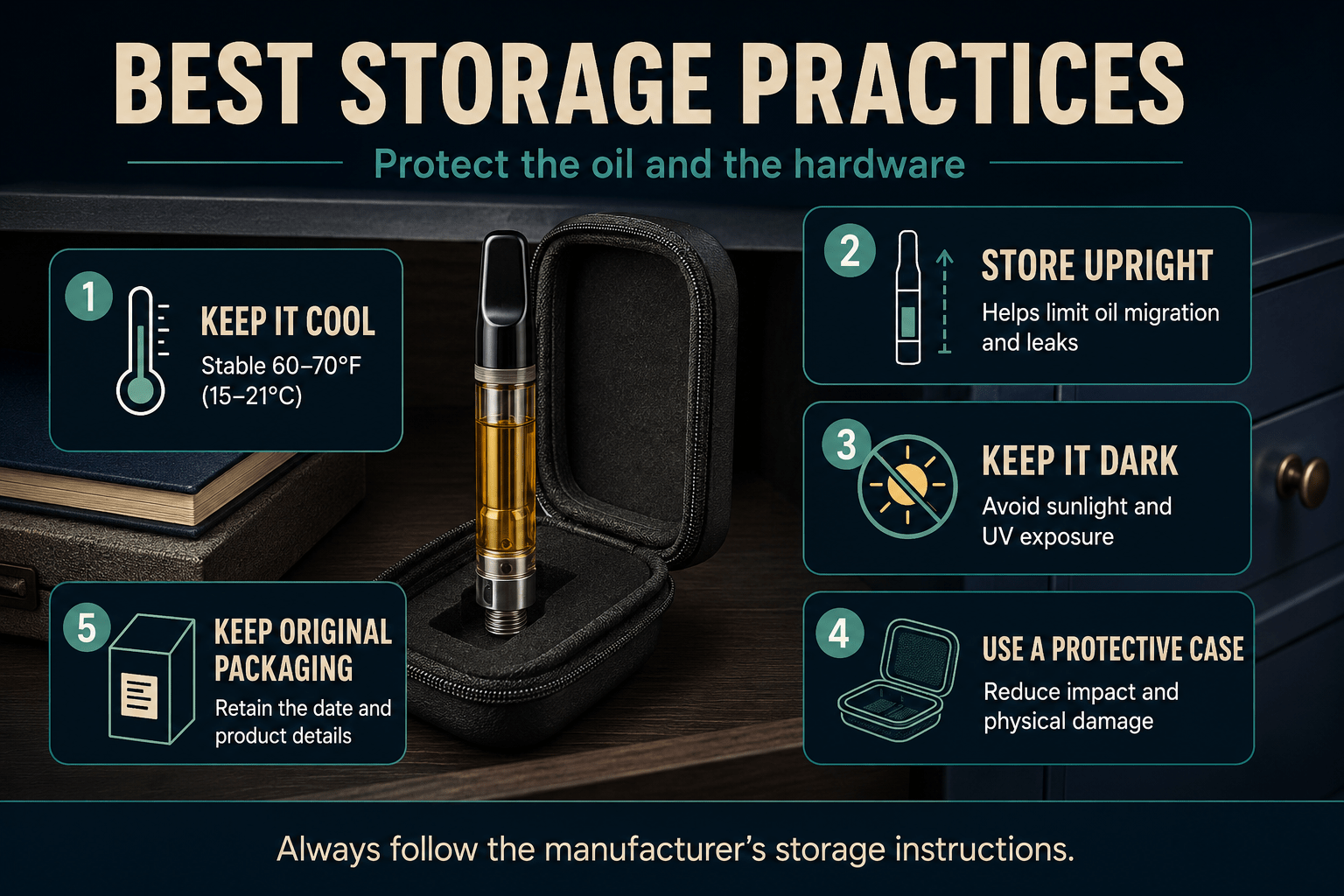
Image lightbox

Proper storage is one of the easiest ways to extend the life of a vape cartridge.
For most consumers, the ideal storage environment includes:
- Temperatures between 60–70°F (15–21°C)
- Relative humidity between 30–50%
- An airtight container or protective case
- Protection from direct sunlight and UV exposure
- Minimal exposure to excess air whenever possible
These conditions help preserve both the cannabis oil and the cartridge hardware over time.
One of the most overlooked storage tips is orientation. Vape cartridges should be stored upright whenever possible. When cartridges sit horizontally for long periods, oil can gradually migrate toward the mouthpiece, increasing the risk of clogs, uneven airflow, and inconsistent vapor production.
Contrary to some internet advice, freezing isn't recommended. Extreme cold can thicken cannabis oil, place stress on cartridge components, and negatively affect performance when the cartridge returns to room temperature.
For most people, the best storage solution is surprisingly simple: a dark drawer, medicine cabinet, closet shelf, or opaque carrying case kept at room temperature. Even for medical patients managing multiple products over several months, refrigeration is generally unnecessary.
The goal isn't creating laboratory conditions. It's simply protecting your cartridge from the factors that accelerate degradation: heat, light, oxygen exposure, and improper storage orientation.
Do weed pens have an expiration date?
Not always.
One reason consumers get confused about vape-cart shelf life is that expiration-date requirements vary significantly depending on where a product is sold.
In the United States, cannabis labeling regulations are largely determined at the state level. Some states require expiration dates on cannabis products, while others do not.
For example, New Jersey regulations specifically require expiration dates under N.J.A.C. Title 17, Chapter 30. Canada follows a different system, requiring standardized cannabis packaging and labeling under the Cannabis Act.
As a result, many vape cartridges display a manufacture date or batch date rather than a clearly labeled expiration date.
If your cartridge only includes a manufacturing date, a reasonable rule of thumb is to consider the product within its peak quality window for approximately six to 12 months after production. Beyond that point, flavor, aroma, and potency may gradually decline even if the cartridge remains usable.
It's also important to remember that the printed date is generally a quality benchmark rather than a hard safety cutoff. A cartridge doesn't instantly become unusable when the calendar reaches a particular day. Instead, the date helps consumers understand when the manufacturer expects the product to perform at its best.
For additional guidance on interpreting packaging information, check the product details carefully and review all available label information before purchase.
Frequently asked questions about weed pen expiration
Do weed pens expire?
Yes. Both the cannabis oil and the cartridge hardware degrade over time. Most vape cartridges maintain their best quality for approximately six to 12 months when stored correctly.
How long do weed pens last before they expire?
Most carts remain in their optimal quality window for six to 12 months. Some unopened cartridges may remain usable for up to 18–24 months, though flavor, aroma, and potency may gradually decline over time.
Can an expired cart still get you high?
Usually, yes. Terpenes are more volatile than cannabinoids and degrade faster, which means flavor declines before significant potency loss occurs. Research suggests cannabinoids remain relatively stable under controlled storage conditions, so older cartridges may still produce noticeable effects even if the experience is less enjoyable.
Is it safe to smoke an expired cart?
For licensed dispensary products, expiration generally means degraded quality rather than an immediate health hazard. However, if a cartridge tastes unusually harsh, appears contaminated, or shows signs of hardware failure, it's best to replace it.
Why did my cart turn dark?
Darkening is caused by oxidation and degradation byproducts that form as cannabinoids age. Contrary to popular belief, pure CBN is nearly colorless and isn't solely responsible for the darker appearance of older cannabis oil.
Should I refrigerate vape cartridges?
Generally, no. Room-temperature storage in a cool, dark environment is sufficient for most consumers. Freezing and excessive cold can negatively affect oil consistency and cartridge performance.
Do live resin carts expire faster than distillate carts?
Both share a six- to 12-month quality window, but live resin is more susceptible to flavor degradation because of its higher terpene content. Proper storage is especially important for preserving live resin's aroma and strain-specific characteristics.
What's the best way to store a weed pen?
Store cartridges upright in a cool, dark location between 60–70°F (15–21°C), away from direct sunlight and excessive heat. An airtight container or protective case can provide additional protection against environmental degradation.
If your cart has seen better days, finding a fresh one is easy. Explore vapes on Weedmaps or find a dispensary near you to compare products, read reviews, and discover new options that fit your preferences.