Cannabis may make some people feel more absorbed in a task, but research hasn't shown that THC reliably improves attention. Higher doses are more likely to impair working memory, reaction time, and sustained focus, so feeling locked in doesn't necessarily mean you're performing better.
 Photo by: Gina Coleman/Weedmaps
Image lightbox

Many people say cannabis helps them lock into a task, whether that's cleaning the house, working on a creative project, or studying for an exam. So, can weed help you focus?
The honest answer is more complicated than a simple yes or no. That feeling can be real, but controlled research hasn't shown that THC improves objectively measured attention. There's an important difference between feeling focused and performing better on attention-based tasks, and understanding that difference is key.
Cannabis use among US adults remains at historic highs, according to NIDA's Monitoring the Future data. Meanwhile, SAMHSA's 2024 national survey estimated that 20.6 million Americans aged 12 and older had a past-year marijuana use disorder in 2024. As more people ask whether cannabis can improve focus, it's important to separate the experience of feeling focused from what researchers can actually measure.
We'll explore why weed can feel like it sharpens your focus, what the research says about THC, CBD, and dosing, and what to consider before using cannabis for work, studying, or everyday tasks.
So, does weed actually help you focus?
The honest answer is that it depends on what you mean by "focus." Many people describe feeling more absorbed in whatever they're doing after using cannabis. They may feel less distracted, more engaged, or better able to settle into a task. But feeling focused and performing better aren't always the same thing.
A 2026 review in Psychopharmacology concluded that the evidence was insufficient to determine whether cannabis improves attention. The same longitudinal review also found that more frequent cannabis use was consistently associated with poorer executive function, the set of mental skills that helps you plan, organize, and stay on task. In other words, today's research doesn't support the idea that cannabis reliably improves attention in a measurable way.
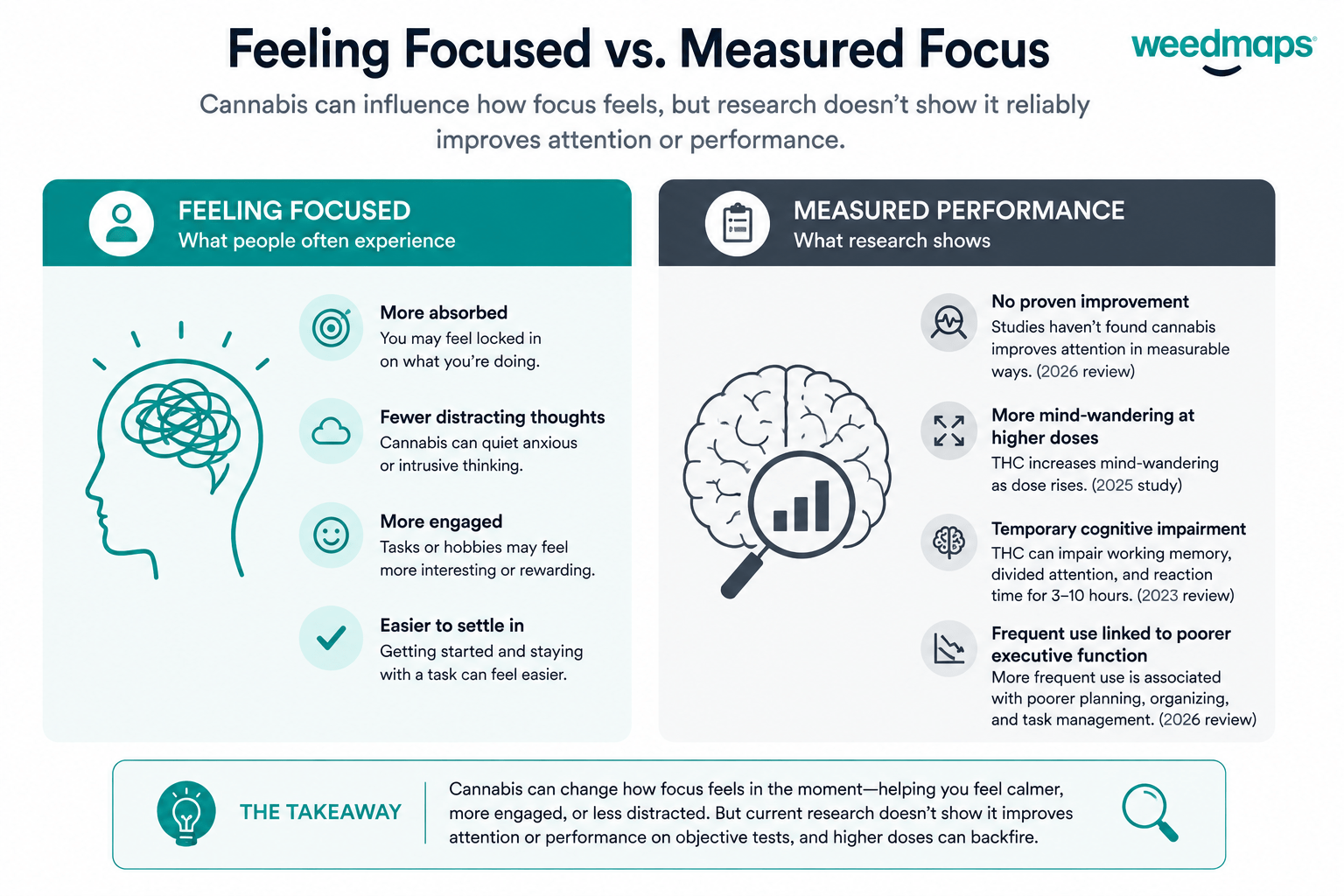
Image lightbox

There's another finding that makes this distinction even more interesting. A 2025 study found that THC increased mind-wandering as the dose rose, which is the opposite of sustained attention. In other words, people may feel locked into an activity while their minds actually drift more during objective testing.
Research also shows that THC can temporarily affect cognitive performance while you're intoxicated. A 2023 systematic review found that acute THC use can impair working memory, divided attention, and reaction time for roughly 3 to 10 hours, with higher doses and oral products generally producing longer-lasting effects.
Why does weed feel like it helps you focus?
If research hasn't shown that cannabis improves attention, why do so many people say it helps them focus?
Part of the answer lies in how THC interacts with the brain. According to research on THC and dopamine, THC activates CB1 receptors throughout the brain, including areas involved in memory, attention, motivation, and reward. Those receptors are part of the body's endocannabinoid system, which helps regulate many everyday functions.
THC also causes a temporary increase in dopamine, a neurotransmitter associated with motivation and reward. Together, those changes may help explain why some people describe feeling more engaged or "dialed in" after using cannabis.
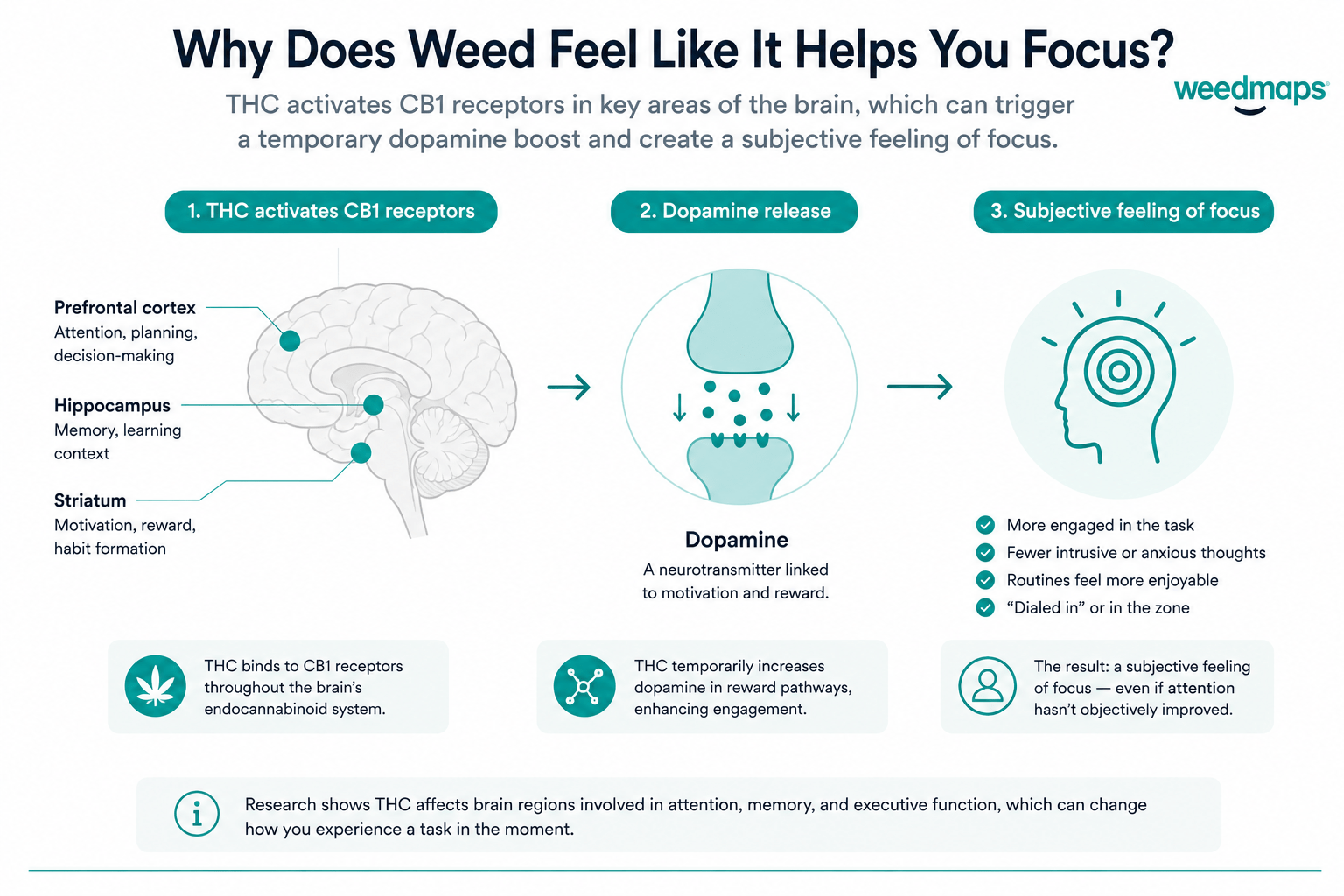
Image lightbox

That experience can also have a practical explanation. Some people find cannabis helps quiet anxious thoughts, while others say repetitive or routine tasks feel more enjoyable. Understood.org, a nonprofit resource for people with ADHD and learning differences, notes that some adults describe feeling more focused after using cannabis because they're less aware of distractions. Feeling calmer or more interested in what you're doing can make it easier to stay with a task, even if your attention hasn't objectively improved.
A 2025 review helps put those experiences into context. THC affects brain regions involved in attention, memory, and executive function, which can change how you experience a task in the moment.
Does dose matter? (Yes, a lot)
Yes. Dose makes a big difference in how cannabis affects your attention. It's easy to assume that if a high dose feels overwhelming, a small dose must do the opposite and sharpen your focus. So far, though, the research hasn't borne that out.
Earlier animal research found what's known as a biphasic effect, where low doses of THC increased dopamine synthesis while higher doses decreased it. That helps researchers understand how THC interacts with the brain, but it isn't evidence that low doses improve focus in people.
Human research points in a similar direction. In a 2015 study, participants who inhaled a higher dose of THC (22 mg) performed worse on a test of divergent thinking. A lower dose (5.5 mg) didn't impair performance, but it also didn't outperform the placebo. In other words, taking less appeared less disruptive, but it didn't make people more focused or more creative.
That's the pattern researchers keep seeing: as THC doses increase, attention is more likely to become scattered. A lower dose may avoid some of that impairment, but it isn't a proven focus enhancer.
You may also hear people talk about microdosing, the practice of taking very small amounts of THC, around one to five milligrams. Some people prefer microdosing for daytime activities because they find the effects easier to manage. At the moment, though, there are no clinical trials showing that microdosing improves focus.
If you're curious about the practice, we've covered microdosing in more detail in a separate guide.
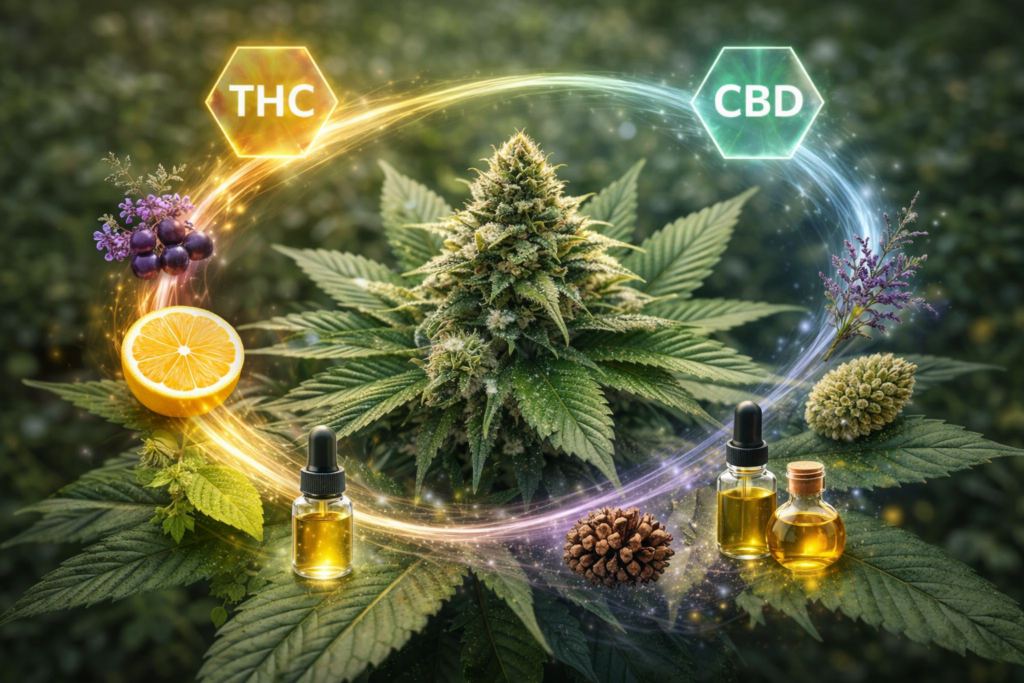
THC vs. CBD, terpenes, and other cannabinoids for focus
If you're looking beyond THC, it's natural to wonder whether another cannabis compound might be a better fit for focus. Right now, the evidence is mixed and it's still emerging.
Research links THC to greater impairment in attention and memory, while CBD appears to have much less impact on cognition. That doesn't mean CBD improves focus, though. Most of the research comparing THC and CBD comes from clinical settings rather than studies of healthy adults trying to concentrate on everyday tasks, so it's too early to draw broad conclusions.
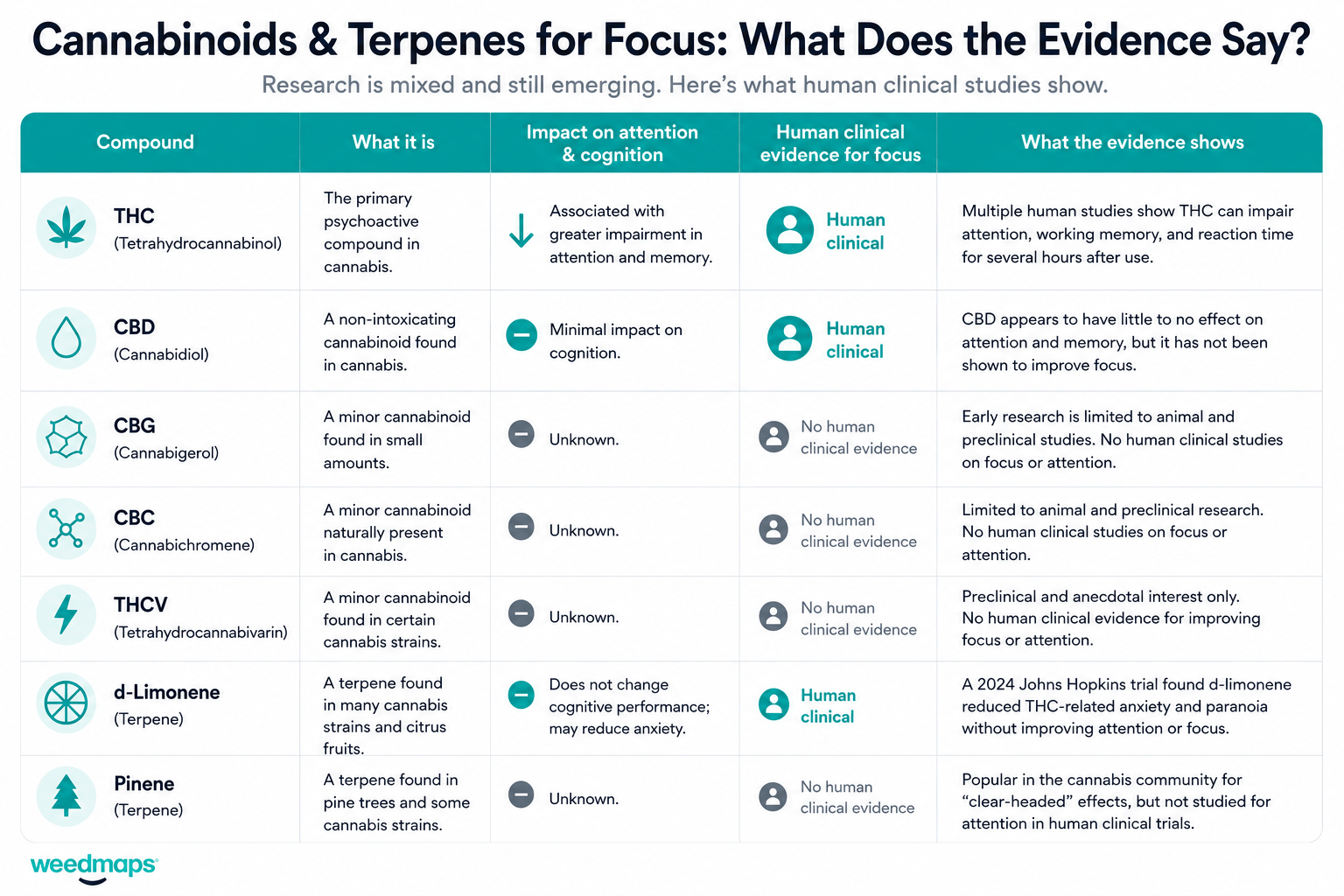
Image lightbox

Terpenes are another area that gets a lot of attention. The strongest human evidence comes from a 2024 Johns Hopkins trial, which found that the terpene d-limonene reduced THC-related anxiety and paranoia without changing participants' cognitive performance or the intensity of the high. In other words, participants felt less anxious, but they weren't any more focused. Feeling calmer can certainly make a task feel easier to tackle, but that isn't the same as improving attention itself.
You may also come across terpenes like pinene and terpinolene in conversations about focus or a more "clear-headed" experience. Plenty of people seek them out for that reason, but researchers haven't tested either terpene for attention in human clinical trials. At this point, the enthusiasm comes from consumer experience rather than clinical evidence.
It's a similar story for minor cannabinoids like CBG, CBC, and THCV. There's growing interest in what these compounds might do, but there isn't any human evidence showing they improve focus.
If you're curious about minor cannabinoids like CBG and THCV, we've covered what researchers know so far in our cannabinoids guide.
Does weed help ADHD focus?
This is one of the most common questions people ask about cannabis. Many adults with ADHD say cannabis helps them feel calmer, less distracted, or better able to settle into a task. A 2020 review also notes that cannabis is the most commonly used illicit substance among people with ADHD, highlighting just how common these experiences are.
That said, there are currently no clinical recommendations or systematic research supporting cannabis as a treatment for ADHD. While many people describe positive experiences, the research hasn't shown that cannabis reliably improves attention or other core ADHD symptoms.
One possible explanation is that cannabis changes how distractions feel rather than how attention works. Some people find they're less bothered by racing thoughts or competing stimuli, making it easier to stay with a task. Feeling less aware of distractions can make it seem like your focus has improved, even when objective measures of attention haven't changed.
It's also important to remember that the lack of evidence isn't the same as evidence of safety. The same trade-offs discussed throughout this article still apply, including the potential for short-term effects on memory and attention. Research also suggests that more frequent cannabis use is associated with poorer executive function, particularly in younger people, whose developing brains appear to be more vulnerable.
What are the downsides and trade-offs?
Every effect comes with a trade-off. While some people feel more engaged or less distracted after using cannabis, those experiences can also come with changes in memory, reaction time, and decision-making that aren't always obvious in the moment.
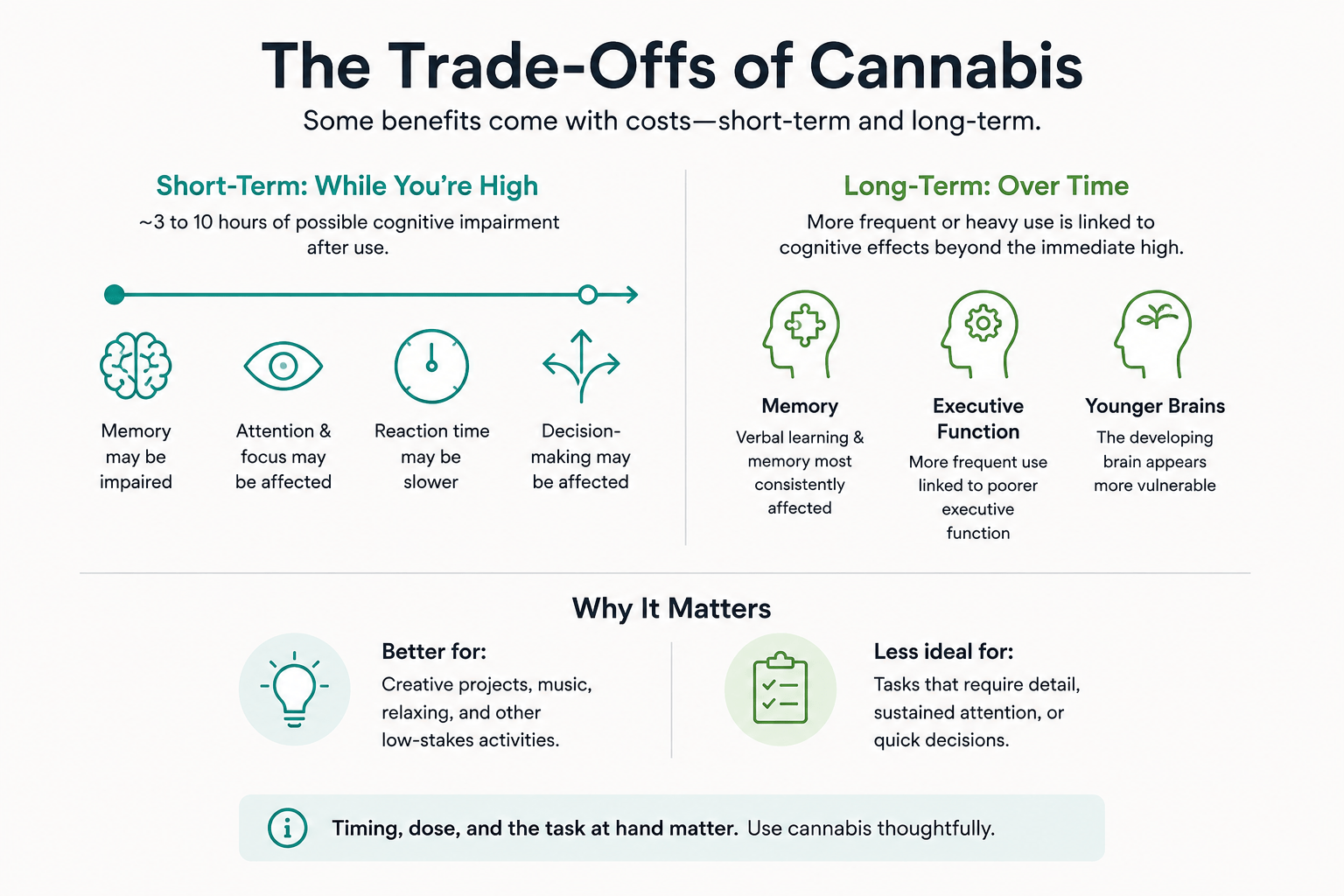
Image lightbox

Beyond the immediate effects, there's also what researchers have found about more frequent use. A 2020 review found that chronic heavy cannabis use is associated with cognitive effects that extend beyond intoxication, with verbal learning and memory showing the most consistent differences. More recent research has also linked more frequent cannabis use to poorer executive function in young people, and the developing brain appears to be more vulnerable.
That doesn't mean everyone will have the same experience. But it does help explain why timing, dose, and the task at hand matter. Some people choose cannabis for creative projects, listening to music, or other low-stakes activities. If you're tackling detail-oriented work or anything that depends on sustained attention and quick decision-making, it's worth considering those trade-offs before you consume.
If you want to try cannabis for focus, do it thoughtfully
If you're still curious about using cannabis before work, studying, or another task that requires concentration, keep a few things in mind.
Start with a low dose and pay attention to how you respond before consuming more. Look beyond indica and sativa labels, and consider the product's cannabinoid and terpene profile instead. If anxiety is what tends to pull your attention away, some people prefer CBD-forward or balanced products, though that isn't the same as improving focus itself.
It's also worth thinking about timing. Many people choose flower or vapes when they want effects that begin more quickly, while edibles tend to last longer and can be less predictable. If you're looking for advice on using cannabis while studying or exploring the best strains for daytime energy, we've covered those topics separately.
Finally, Weedmaps is an educational resource, not a source of medical advice. If you're considering cannabis for a health-related reason, talk with a qualified healthcare professional. When you're ready to shop, Find Dispensaries Near You on Weedmaps to compare products from licensed retailers.
Frequently asked questions
Is weed a focus drug?
Not in the way prescription stimulants are. Research hasn't shown that cannabis improves objectively measured attention, and THC can temporarily impair focus, memory, and reaction time during intoxication.
Does weed give you hyper focus?
Some people describe a "locked-in" or hyperfocused feeling after using cannabis. However, a 2025 study found that THC increased mind-wandering as the dose rose, suggesting that feeling focused isn't always the same as performing better on attention-based tasks.
Is CBD or THC better for focus?
Research generally links THC to greater impairment in attention and memory, while CBD appears to have much less impact on cognition. Neither has been proven to improve focus in healthy adults.
Is weed good for ADHD focus?
Some adults with ADHD say cannabis helps them feel calmer or less distracted, but there are no clinical recommendations supporting cannabis as an ADHD treatment. If you're considering cannabis for ADHD or another health condition, talk with a qualified healthcare professional.
Does weed decrease focus?
It can. Research shows that THC may temporarily impair attention, working memory, and reaction time for roughly 3 to 10 hours after use, with higher doses and edibles generally producing longer-lasting effects.