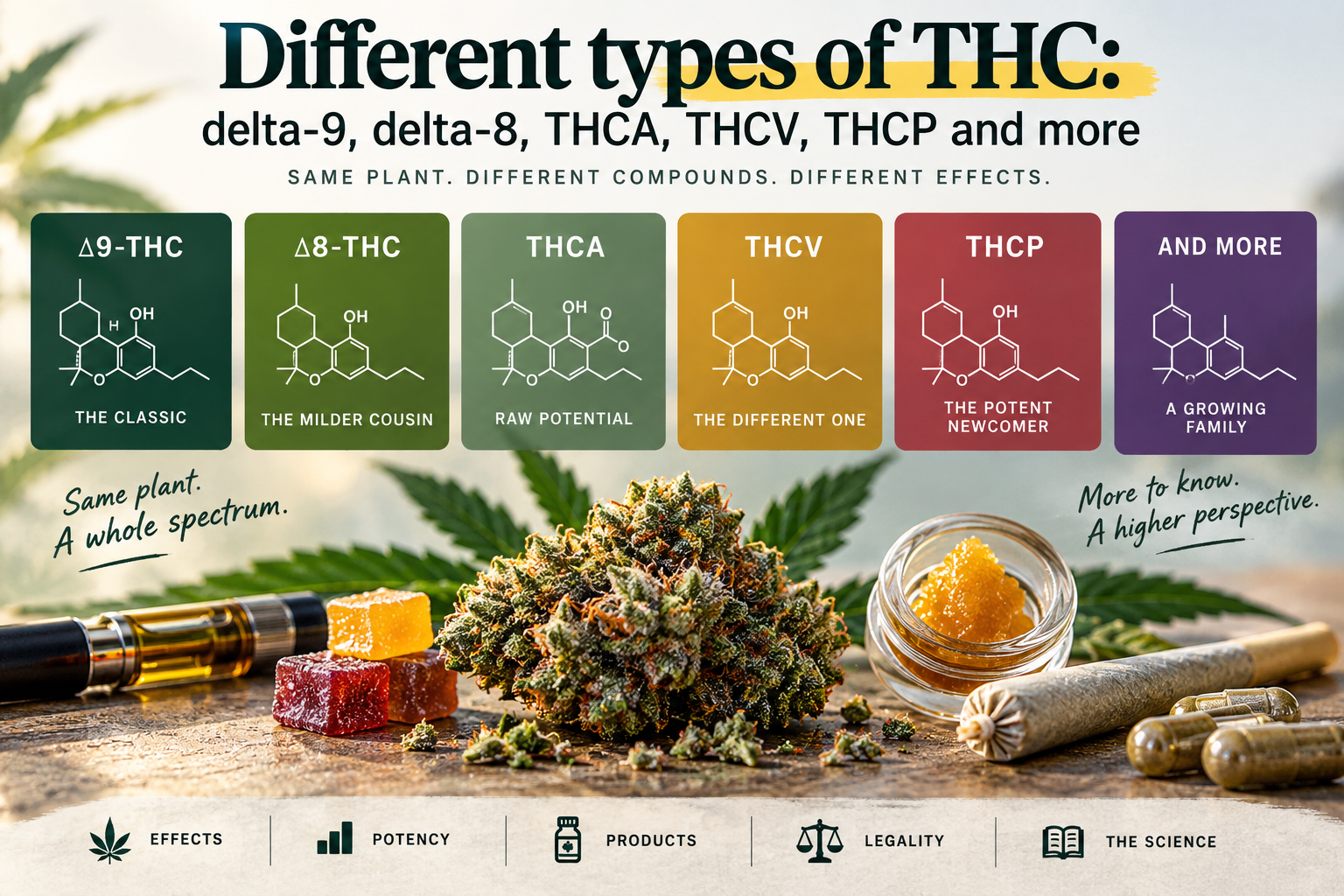
THC isn't just one thing. From delta-9 and delta-8 to THCA, THCV, and THCP, here's how the different types compare in potency, effects, products, and legality.

Image lightbox

THC is the cannabinoid everyone knows. It's the one most associated with getting high, and when you see "THC" on a label or hear someone talking about it, they're usually referring to delta-9 THC.
But delta-9 isn't the only THC out there.
Cannabis contains more than 100 cannabinoids, and the broader THC family includes delta-8, delta-10, THCA, THCV, THCP, and other closely related compounds.
They're chemically similar, but they don't all play by the same rules. Some can get you high, some only become intoxicating under certain conditions, and a few are so lightly studied that there's still plenty we don't know. So when a product starts throwing THC acronyms at you, it's worth knowing which one you're actually looking at.
Types of THC at a glance
Once you get past delta-9, the THC family gets a little crowded. And while the names may look similar, the differences can matter when it comes to potency, intoxication, the products you'll find them in, and even how much we actually know about them.
Here's how they stack up:
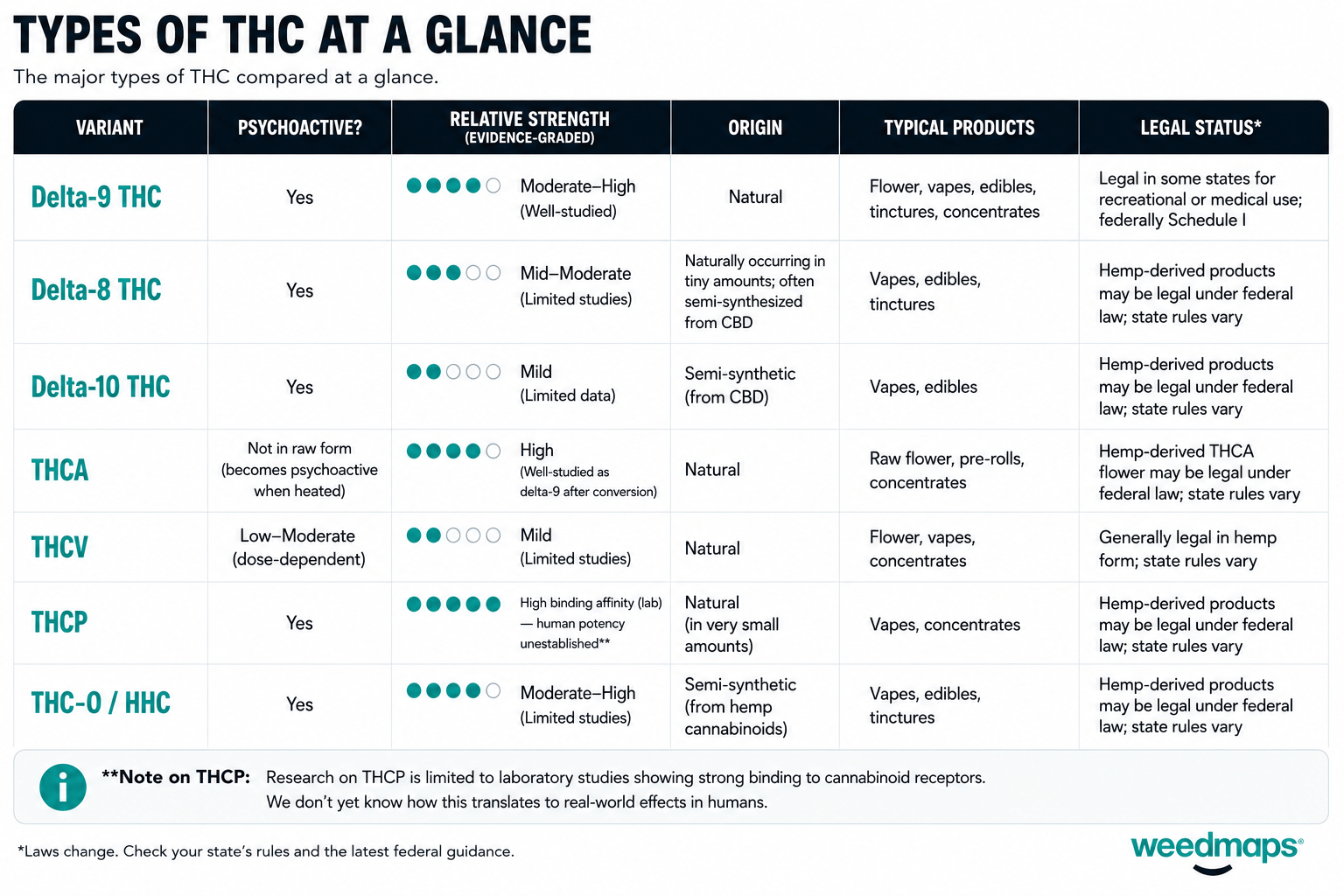
Image lightbox

Delta-9 THC: the classic
Delta-9 needs little introduction. It's been the familiar face of THC for a long time. If you have a bag of edibles or some pre-rolls tucked away in a drawer right now, there's a good chance this is the THC in them. It's the main intoxicating cannabinoid in cannabis and the one behind the classic cannabis high.
But what makes delta-9 intoxicating?
Delta-9 THC interacts with CB1 and CB2 receptors, which are part of the endocannabinoid system. More specifically, it's a partial agonist, meaning it activates those receptors without producing their maximum possible response.
That's where the familiar delta-9 experience comes in. People often describe feeling euphoric, hungry, or both, though how it hits can change with the dose, the product, your tolerance, and your own response to cannabis.
Delta-9 is also the benchmark for the THC types coming next. When another variant is described as stronger or milder, this is usually the one it's being compared to.
Delta-8 THC: the milder cousin
Delta-8 looks a whole lot like delta-9 on paper, but it has a reputation for being the mellower cousin. Human research gives us some numbers to work with, but the comparison isn't as simple as calling delta-8 "half as strong."
In a 2025 controlled human study, researchers found that a 40 mg oral dose of delta-8 produced effects comparable to 20 mg of delta-9. That puts delta-8 at roughly half the potency by dose under those specific oral-study conditions.
But don't turn that into a universal 2:1 rule.
A separate 2025 controlled study of vaporized delta-8 and delta-9 directly compared 10 mg, 20 mg, and 40 mg doses of vaporized delta-8 with 20 mg of vaporized delta-9. Several delta-8 doses produced broadly comparable psychoactive effects, and researchers also found that participants changed how they puffed depending on the dose.
In other words, route of administration, dose, and even how people inhale can scramble any neat milligram-for-milligram comparison.
There's also something worth knowing about the delta-8 you see in shops. The cannabis plant only makes tiny amounts of it naturally. To produce enough for commercial products, manufacturers commonly start with CBD and chemically convert it into delta-8.
That process can leave unwanted impurities behind if the finished product isn't properly purified. So this is one of those times when it pays to actually open the lab report instead of scrolling past it. Look for recent third-party testing that shows you what's in the product before you buy.
Delta-10 THC: the lesser-known isomer
Delta-10 is one of the more elusive members of the THC family. It's another isomer of THC that sometimes turns up in hemp-derived products, though you're less likely to run across it than delta-8 or delta-9.
You may see delta-10 marketed as a milder THC with its own distinct kind of high, but there just isn't much human research digging into its potency or effects yet.
For now, the marketing is moving faster than the science.
THCA: the raw, non-intoxicating precursor
If you look closely at the label on cannabis flower, you might notice THCA listed in much bigger numbers than delta-9 THC. There's a reason for that. In raw cannabis, much of the potential THC is actually sitting there as THCA.
In its raw, unheated form, THCA isn't intoxicating. That changes when you add heat. Light a joint, hit a vape, or cook with cannabis, and decarboxylation converts THCA into delta-9 THC.
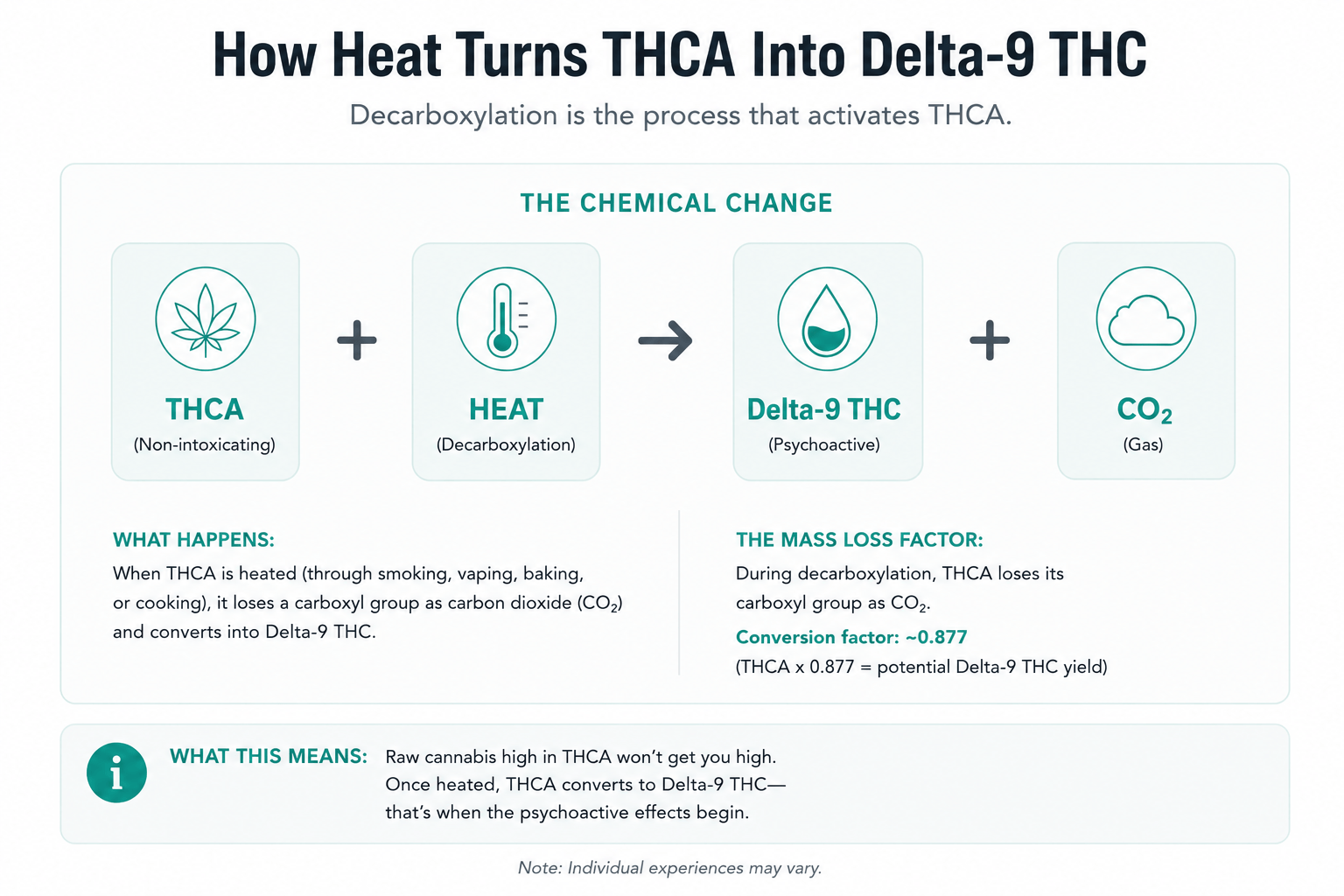
Image lightbox

The conversion isn't perfectly one-to-one. THCA loses carbon dioxide during the process, which is why 100 mg of THCA can't theoretically become 100 mg of delta-9 THC. The molecular-weight conversion factor is about 0.877, although real-world decarboxylation isn't perfectly efficient.
This distinction between THCA before heating and delta-9 after heating is also part of what has made THCA flower such a complicated legal category. Products can contain relatively little delta-9 THC before use while carrying much larger amounts of THCA.
That federal equation is about to change, though. More on that below.
THCV: the different one
THCV is a bit of an outlier in the THC family.
Unlike delta-9, lower doses of THCV don't appear to produce the typical cannabis high. According to a 2025 THCV pharmacology review, an oral dose around 10 mg wasn't intoxicating. At higher doses, its effects may change, though much of what we know about that so far comes from preclinical research.
You may also see THCV products marketed around appetite or metabolism. There's some early research exploring those effects, but the evidence is still limited, so it's too early to promise what you'll experience if you use this cannabinoid.
The science is interesting. The "diet weed" nickname is getting ahead of it.
THCP: the potent newcomer and the "33×" myth
If you've seen THCP described as "33 times stronger than THC," there's an important piece of context missing.
THCP was first identified in 2019 and has a slightly different chemical structure than delta-9. In the original 2019 THCP discovery study, researchers found that THCP had about 33 times greater binding affinity for CB1 receptors than delta-9 THC.
Put simply, THCP was much better at binding to these receptors in the lab.
That's where the "33×" number comes from.
It doesn't mean THCP gets you 33 times higher.
So how much stronger does it actually feel? We don't know yet. THCP hasn't been directly compared with delta-9 in controlled human research in a way that gives us a reliable potency multiplier.
THCP does occur naturally in cannabis, but only in tiny amounts. That means the THCP you see in commercial products typically isn't extracted in meaningful quantities straight from ordinary flower.
Novel and semi-synthetic variants: THC-O, HHC, and others
Once you move beyond the THC variants commonly discussed in cannabis, things get murkier.
THC-O acetate, for example, doesn't occur naturally in the plant. It's produced through a chemical process. In 2023, the DEA determined that delta-8-THC-O and delta-9-THC-O do not qualify as hemp and are controlled as Schedule I tetrahydrocannabinols under federal law.
HHC is another one you may have seen popping up in gummies, vapes, and other products. Trace amounts can occur naturally, but commercial HHC is generally produced by chemically converting other cannabinoids. There's still considerably less human research on HHC than there is on delta-9 THC.
And just to clear up a common mix-up: semi-synthetic cannabinoids sold as HHC aren't the same thing as synthetic cannabinoid products such as Spice or K2. Those are different compounds with different pharmacology.
THC vs. CBD
THC and CBD get talked about together all the time, but they're not interchangeable.
The biggest difference is probably the one you already know: when it comes to THC vs. CBD, delta-9 THC is associated with the intoxicating high from cannabis, while CBD isn't.
You'll find CBD on its own, alongside THC, or in products that contain a mix of both. So when you're checking a label, don't read the CBD number as extra THC. A product can contain plenty of CBD without that making it more intoxicating.
How THC shows up in products
The THC types we've covered don't all show up in the same places.
THCA is what you'll commonly find in raw flower and pre-rolls before they're heated, while delta-9 is common across edibles, vapes, concentrates, and tinctures.
Delta-8, THCP, HHC, and other newer or commercially converted cannabinoids are more likely to turn up in manufactured products like gummies and vapes.
The product you choose also affects when the THC shows up for you. Inhaled cannabis can take effect within minutes, while edibles take longer to kick in and can last longer.
That delay is one reason it's easier to take too much before you realize the first dose has hit.
With edibles, patience pays off. Give the first dose plenty of time before reaching for more. And if you're trying a THC variant or product you don't know, start low and see how you respond before adding more.
Why potency matters
Cannabis has gotten a lot stronger over the years.
Data from the NIDA-funded Potency Monitoring Program show average delta-9 THC concentration in cannabis samples seized by the DEA rising from roughly 4% in 1995 to about 16% in 2022.
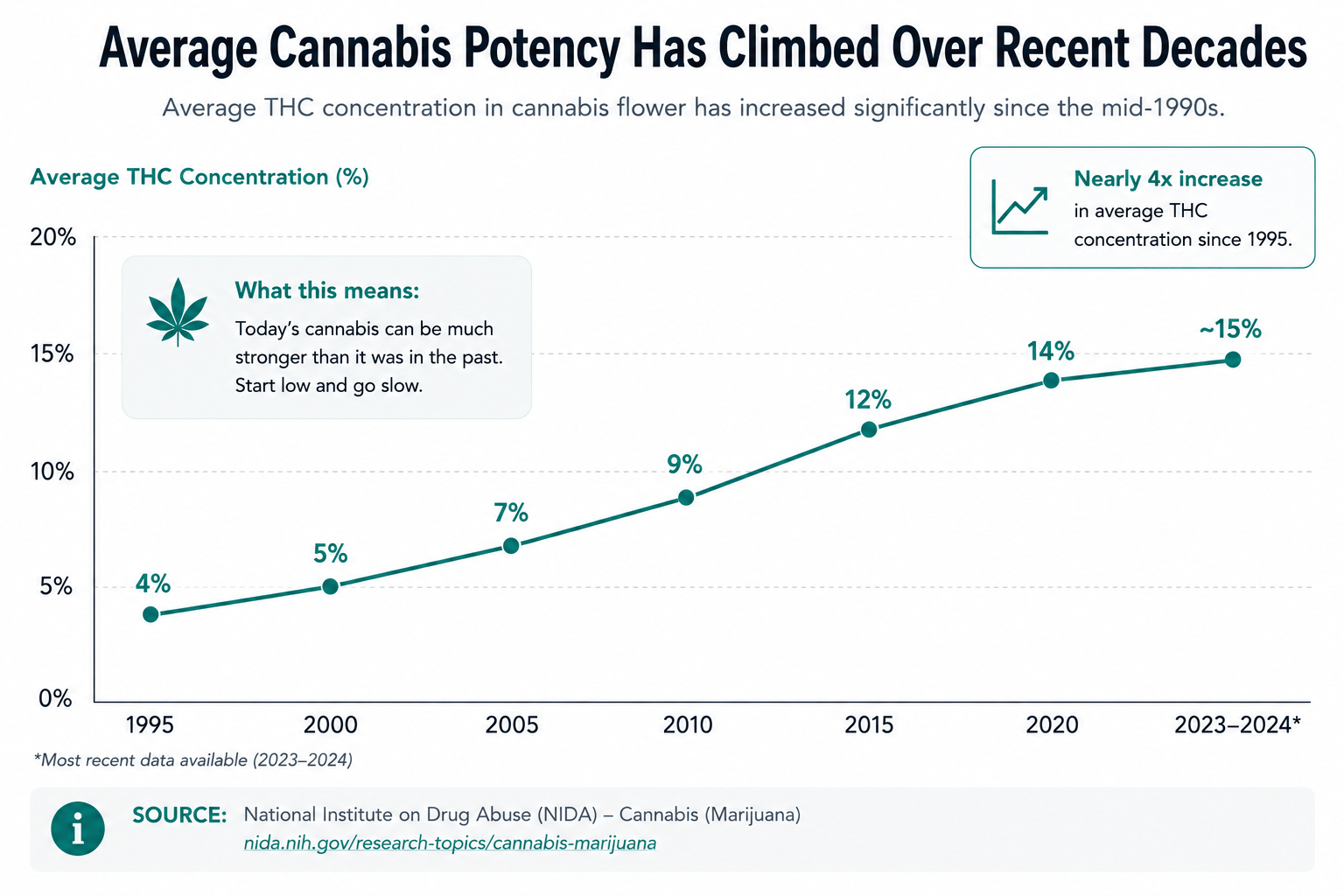
Image lightbox

That's historical seizure data, not a claim that 16% represents the average flower currently sitting on dispensary shelves.
A high-potency concentrate can deliver much more THC by weight than flower, and with newer cannabinoids, we don't always know exactly how their potency stacks up against delta-9.
The number on the label can help you know what you're getting into. Check the potency and serving size before you start, especially with a product or THC variant you haven't tried before.
You can always have more. You can't rewind the dose you already took.
Are the different types of THC legal?
This is where the legality of different types of THC gets hazy.
In the US, legality can depend on the cannabinoid, where it came from, how it was produced, what kind of product it's in, and the state you're in.
Under the federal hemp definition currently in effect, cannabis containing no more than 0.3% delta-9 THC by dry weight can qualify as hemp. That distinction helped create a market for hemp-derived cannabinoids like delta-8, as well as THCA flower.
Federal marijuana scheduling changed in part during 2026, but not across the board.
FDA-approved products containing marijuana and marijuana products covered by qualifying state medical-marijuana licenses have been placed in Schedule III. The remainder of marijuana is still federally listed in Schedule I while a separate proceeding considers whether it should also move to Schedule III.
The hemp rules are changing, too.
A new federal definition of hemp is scheduled to take effect November 12, 2026. Among other changes, it replaces the current delta-9-only threshold with a total THC standard that includes THCA. The new definition also excludes certain manufactured or synthesized cannabinoids and imposes additional limits on final hemp-derived cannabinoid products.
That change is likely to reshape much of the market built around intoxicating hemp products.
States can have their own rules for marijuana and hemp-derived cannabinoids, too. So before buying delta-8, THCA flower, or another THC product, check your state's current laws rather than assuming that what's available somewhere else is legal where you live.
Frequently asked questions
How many types of THC are there?
There isn't one neat number.
Cannabis contains more than 100 cannabinoids overall, and the broader THC family includes compounds such as delta-9, THCA, THCV, THCP, delta-8, and delta-10.
The commercial cannabinoid market complicates that answer even further with chemically converted cannabinoids and THC derivatives that aren't simply another naturally abundant form of THC.
Which type of THC is the best?
There's no universal winner.
The best fit depends on the experience you're looking for, your tolerance, the product you prefer, how much research exists on the cannabinoid, and what's legal where you live.
Which is stronger, THCA or THCP?
It's not quite an apples-to-apples comparison.
THCA isn't intoxicating in its raw form. Heat converts it into delta-9 THC.
THCP binds much more strongly to CB1 receptors than delta-9 in laboratory testing, but we still don't have controlled human research telling us exactly how potent THCP feels compared with delta-9.
Thirty-three times the binding affinity is not the same thing as 33 times the high.
What is a better high: sativa or indica?
Neither is automatically "better."
How cannabis hits you can depend on the product's cannabinoid and terpene profile, potency, dose, product type, and your own response, so the sativa or indica label only tells you so much.
Are the different types of THC legal?
It depends on the type of THC, the product, how it was produced, and where you live.
Federal hemp law is scheduled for a major change on November 12, 2026, while states can impose their own rules on both marijuana and hemp-derived cannabinoids.
Check current local laws instead of treating "hemp-derived" as another word for legal.
Will the different types of THC show up on a drug test?
They can, so don't assume a different type of THC will get around a drug test.
Delta-8, for example, can produce metabolites that cross-react with cannabinoid drug-testing assays. Depending on the cannabinoid and the test being used, switching away from delta-9 doesn't guarantee a negative result.
If passing a drug test matters, "it's not delta-9" isn't a loophole worth betting on.
The bottom line
There's a lot more to THC than delta-9. Different types can vary in how intoxicating they are, where they show up, how much we know about them, how they're produced, and whether they're legal where you live.
If you're trying something new, check the label and COA so you know which cannabinoid you're actually getting and how much is in there.
And with federal hemp rules changing on November 12, 2026, yesterday's cannabinoid loophole may not be tomorrow's law.
Ready to see what's available? Find dispensaries near you and explore products on Weedmaps.