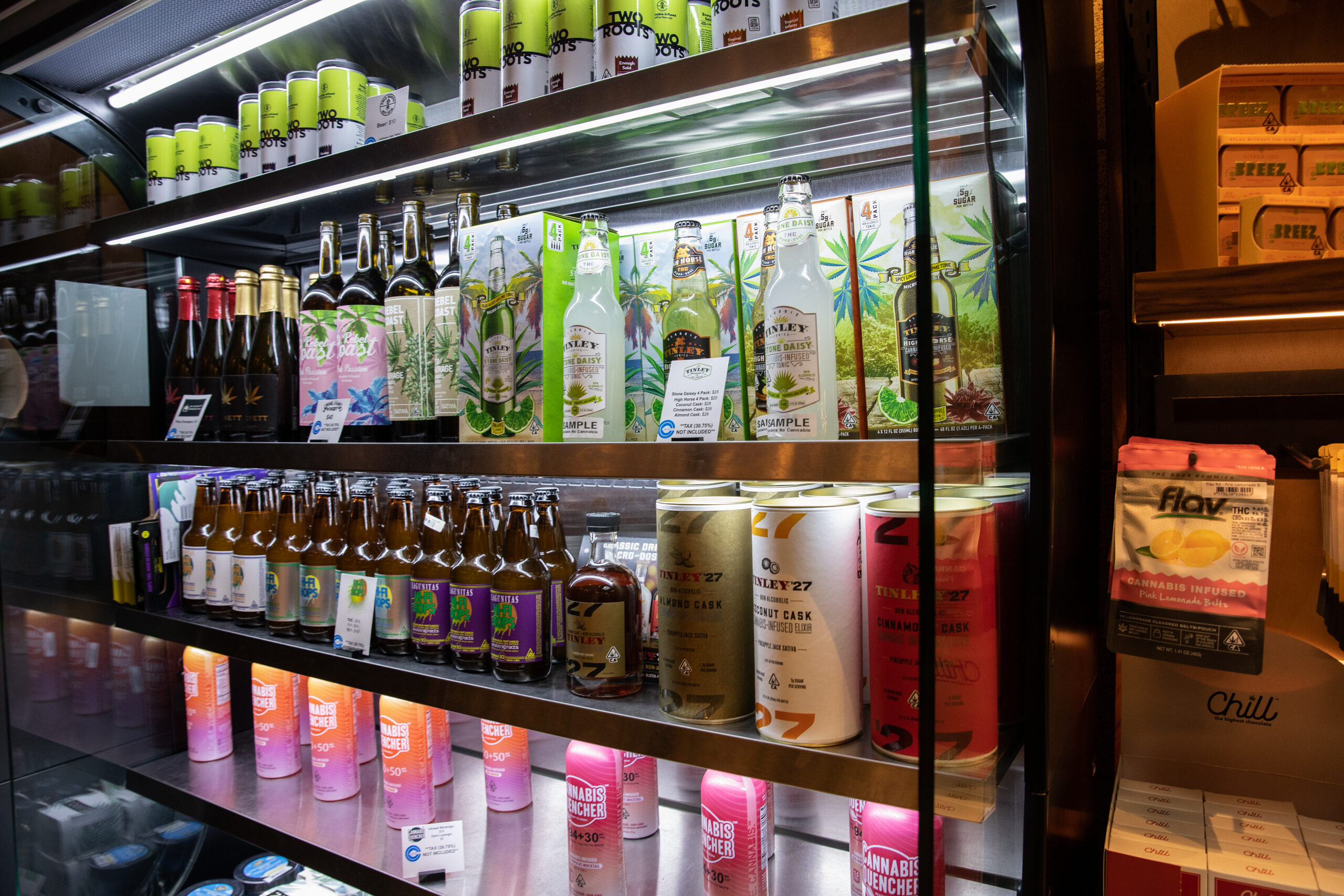
Still THC drinks deliver cannabinoids more consistently than sparkling ones — no gas pressure, no turbulence, no uneven dispersion spikes. The result is a gradual onset you can actually track, instead of a spike you're chasing after the fact.

Image lightbox

Most THC drink content stops at flavor profiles and "hits faster" claims. Neither tells you what's actually happening once the liquid is in your body.
A THC beverage is a delivery system. How it moves through your stomach and into your intestines determines how the effect arrives — and whether you can predict it. Carbonation changes that equation in ways most people haven't thought through.
What happens to THC after you drink it
Once you take a sip, the process is already in motion, but not where most people think.
Stomach entry and initial mixing
THC is fat-soluble — it doesn't dissolve into liquid, it's suspended in it as an emulsion. The quality of that emulsion, how stable and evenly distributed the droplets are, matters more than most people realize. When the drink hits your stomach, that emulsion starts mixing with whatever's already there: water, food, digestive fluids. Almost no absorption is happening yet.
Gastric emptying into the small intestine
Your stomach is the gatekeeper.
It doesn't absorb much THC itself — it controls when the liquid gets released into the small intestine, where absorption actually happens. That timing isn't uniform. Some liquids move steadily. Others move in bursts. What's in the liquid, and how it behaves under pressure, shapes the pattern you get.
Intestinal absorption
Once the liquid reaches the small intestine, THC starts crossing into the bloodstream.
This depends on surface area contact:
- More even contact → more consistent absorption
- Uneven contact → unpredictable uptake
At this stage, the structure of the liquid matters a lot more than people realize.
Liver conversion
After absorption, THC moves through the liver via first-pass metabolism, where a portion converts into 11-hydroxy-THC — a metabolite that tends to hit harder and last longer than THC itself. How quickly THC arrives at the liver shapes how intense that conversion feels. Steady delivery and fast delivery don't produce the same result here.
How carbonation changes what happens in the stomach
CO₂ expansion and pressure: Carbonated drinks release gas as they warm up inside your stomach. That gas expands, increasing internal pressure and volume. You feel it as bloating — but the mechanical effect goes deeper than discomfort.
Altered gastric emptying patterns
That pressure disrupts how the stomach releases its contents. Instead of a controlled flow into the small intestine, carbonation produces an uneven pattern — slowed, then pushed through in bursts. The timing becomes harder to predict.
Internal agitation
Bubbles move constantly. That movement creates turbulence inside the liquid, which shifts how THC droplets are distributed as the drink sits in your stomach. It's not a static suspension anymore — it's being shaken from the inside throughout the process.
How still liquids move through the same system
Remove the carbonation, and the whole process calms down.
Without CO₂, there's no expansion pushing against the stomach walls. The liquid behaves like liquid — no internal pressure shifts, no force working against consistent emptying.
Consistent gastric emptying flow
Still liquids leave the stomach in a more uniform pattern. Biology isn't perfectly predictable, but without gas disruption, the timing tightens up considerably.
Lower internal agitation
No bubbles means no turbulence. The emulsion stays stable as it moves, which keeps THC more evenly distributed through the full transit.
Why cannabinoid dispersion determines absorption behavior

Image lightbox

This is where the experience actually diverges.
THC is suspended in the liquid as tiny droplets. How evenly those droplets stay distributed determines what the intestinal lining is actually encountering during absorption.
Stable dispersion — think a properly emulsified vinaigrette — means every moment of contact delivers a consistent dose. Unstable dispersion means some moments are heavier, some are nearly empty. That inconsistency translates directly into absorption:
- Even distribution → steady uptake, controlled delivery
- Uneven distribution → variable uptake, unpredictable peaks
Still beverages hold stable dispersion better. Without bubbles constantly disrupting the liquid, THC stays spread more evenly through transit — and absorption reflects that.
How these factors shape the absorption curve
Now everything connects.
This is where the experience differences actually come from.
Carbonated drinks
Gas pressure, internal agitation, and shifting dispersion combine into a system that delivers THC unevenly into the intestine. Faster pockets of absorption create a sharper onset — which is why sparkling THC drinks often feel like they hit quicker. The tradeoff is less control over intensity.
Still drinks
Consistent stomach emptying, stable emulsion, and lower agitation produce a gradual buildup instead of a spike. Absorption happens across a longer window rather than front-loading into a single peak.
Peak vs plateau behavior
Faster, uneven delivery produces a higher peak and a shorter window. Slower, steady delivery produces a moderate peak with a longer plateau. Same THC dose — different curve, different experience.
The bottom line

- Pressure in your stomach
- How the liquid moves
- How evenly THC stays distributed
- When and how absorption happens
Take it out, and the system becomes more predictable. Same ingredient. Different delivery. Order cannabis drinks for pickup or delivery from a dispensary near you.