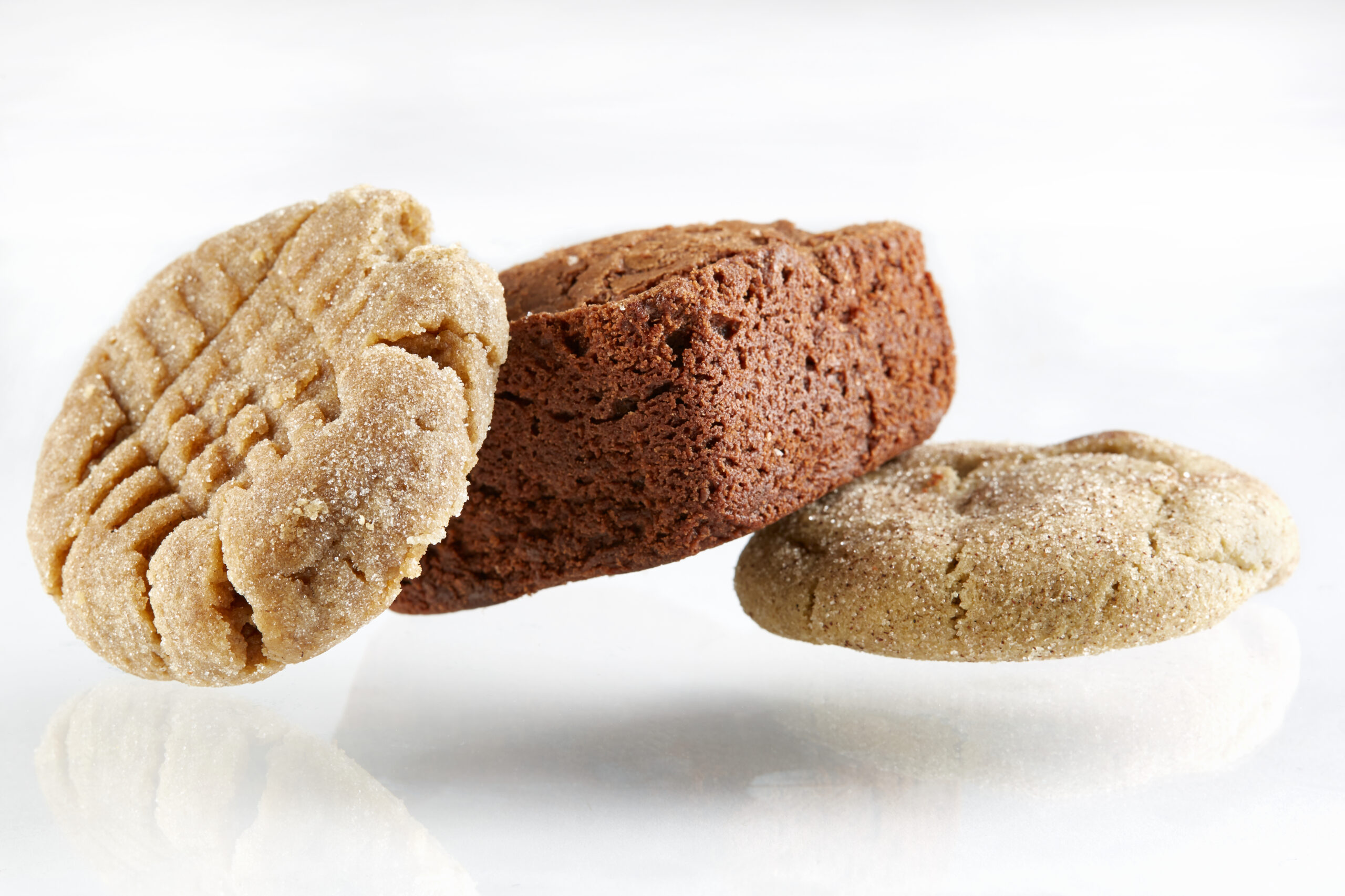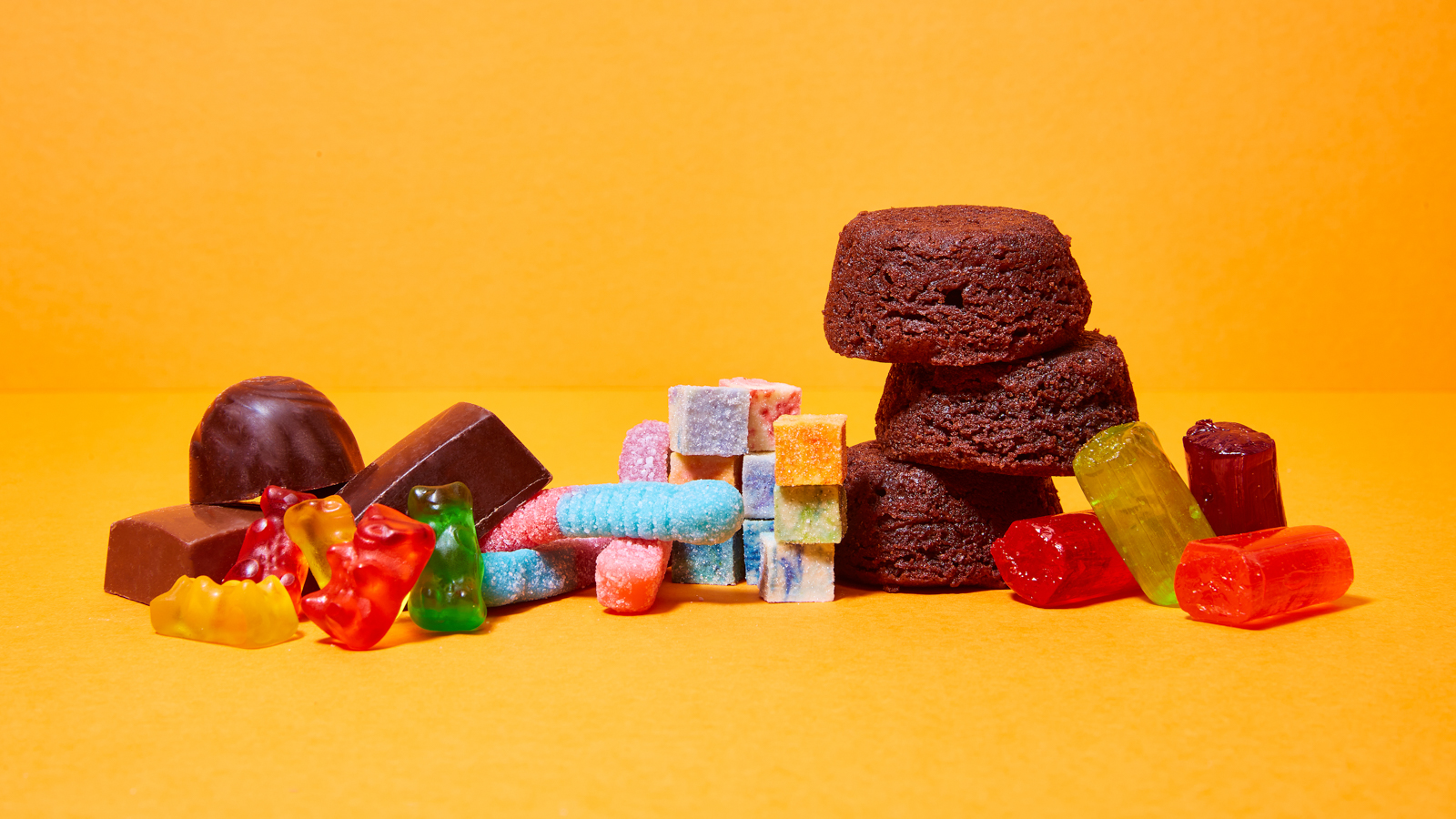
Chocolate edibles bind THC to fat, which changes how it moves through digestion, how much gets absorbed, and how long it sticks around. Gummies don't have that fat system, so they move faster, hit differently, and taper off sooner.
 Photo by: Gina Coleman/Weedmaps
Image lightbox

THC doesn't behave like most food compounds. It's not water-soluble, it's fat-soluble.
That means:
- THC doesn't dissolve well in sugary, water-based systems
- It prefers to bind to fats (lipids)
Gummies are mostly sugar and gelatin. There's not much fat there.
Chocolate is built on cocoa butter, a dense fat matrix. So right out of the gate, THC is interacting with two completely different environments.
That's the root of everything that follows.
What happens when THC enters the stomach
Once you eat it, both gummies and chocolate go to the same place, your stomach. But they don't behave the same once they get there.
Gummies break down fast
Gummies dissolve quickly.
Sugar pulls in water, breaks apart, and releases THC early in the digestive process. There's not much holding it in place.
Chocolate holds onto THC
Chocolate melts, but it doesn't just fall apart.
The cocoa butter keeps THC bound inside fat. Instead of releasing all at once, THC stays embedded in that lipid structure.
So at this stage:
- Gummies = THC gets released early
- Chocolate = THC stays packaged in fat
Fat changes how long THC stays in the stomach
Fat slows things down. That's not a guess, it's how digestion works.
When fat enters your stomach:
- It delays gastric emptying
- Food sits longer before moving to the small intestine
Since chocolate is fat-heavy:
- It hangs out in the stomach longer
- THC stays tied up in that fat while it does
Gummies don't have that delay. They move through faster. This is where timing starts to split.
Where absorption actually happens: the small intestine
Here's the part most people miss: THC isn't really absorbed in the stomach. The real absorption happens in the small intestine.
That's where cannabinoids cross into your bloodstream, and how they get there depends on what they're traveling with.
How fat increases THC absorption
This is the key mechanism.
When fat reaches the small intestine, your body releases bile. Bile breaks fat down into tiny structures your body can absorb.
THC sticks to those fat particles.
So instead of floating around on its own, THC:
- rides along with digested fats
- passes more easily through the intestinal wall
- enters the bloodstream more efficiently
Gummies don't have this system. There's no fat to carry THC through the same pathway.
So the difference looks like this:
- Chocolate → THC gets a “ride” into your system
- Gummies → THC goes in without that boost
More efficient absorption = more THC making it into circulation.
What happens after absorption: liver metabolism
Once THC enters your bloodstream, it goes straight to your liver.
There, it gets converted into 11-hydroxy-THC, a compound that:
- Crosses into the brain easily
- Is commonly associated with stronger, longer-lasting effects
Both gummies and chocolate go through this step.
The difference is upstream:
- Chocolate delivers more THC into the system
- More THC reaches the liver
- More gets converted
Same process, different input.
How fat creates a slower, extended release of THC

Image lightbox

Fat doesn't just help absorption, it stretches it out.
Because THC stays tied to lipid digestion:
- it doesn't all enter the bloodstream at once
- absorption happens over a longer window
That creates a staggered release instead of a single spike.
Gummies don't have that buffer. Once they break down, THC moves through more quickly.
How these mechanisms change the experience
Now the differences actually show up.
Onset timing
- Gummies release THC early → effects show up sooner
- Chocolate delays release → onset takes longer for many users
Intensity
- Chocolate absorbs more THC overall
- More THC reaches the liver → more conversion
- Many users report stronger effects with chocolate edibles
Duration
- Gummies move through quickly → shorter window
- Chocolate releases THC over time → longer-lasting effects
Why chocolate edibles can feel layered
Because absorption is stretched out, the experience doesn't come in one clean wave.
It builds.
You might notice:
- an initial onset
- followed by a continued rise
- sometimes a second peak later on
People often call this the “second wave.”
It's not random, it's the fat-driven release curve playing out.
Why gummies feel more consistent
Gummies are simpler.
- Each piece is pre-measured
- There's no fat slowing or stretching digestion
- THC moves through a more predictable path
That's why people lean on gummies for consistency.
Chocolate can vary more depending on:
- how much you eat
- what else is in your system
- how your body handles fat digestion
Chocolate vs gummies: what actually changes in your body
This isn't about flavor, it's about the system.
Chocolate edibles
- high fat content
- slower digestion
- higher THC absorption
- extended release
- longer duration
Gummies
- low fat content
- faster digestion
- lower relative absorption
- quicker release
- shorter duration
Same THC. Different delivery.
Choosing between chocolate and gummies comes down to the experience you want
Go with chocolate if you're looking for:
- a longer ride
- a more gradual build
- effects that stick around
Go with gummies if you want:
- faster feedback
- tighter timing
- easier, repeatable dosing
Neither is “better.” They just run on different systems.
The bottom line

Chocolate changes how THC moves through your body because of one thing: fat.
That fat affects:
- how long THC stays in your stomach
- how efficiently it's absorbed
- how much reaches your liver
- and how long it keeps releasing into your system
Once you see that pipeline, the difference between chocolate and gummies stops feeling random and starts feeling predictable.
If you're comparing edibles or trying to dial in what works for you, Weedmaps makes it easy to explore products, check THC content, and find options near you, without guessing.