hybrid
Flavors
- Earthy (43% of reported flavors)
- Sweet (29% of reported flavors)
- Flowery (29% of reported flavors)
Jupiter OG is a strain widely attributed to California's Planetary OG series, where it sits alongside Mars OG and Saturn OG as a distinct OG Kush phenotype that first appeared in the Bay Area during the late 1990s, later propagated by The Cali Connection. The Cali Connection's seed version crosses the original clone-only Jupiter OG Kush cut with Tahoe OG S1. Breaking apart the buds releases earthy woodiness and pungent fuel up front, settling into skunky undertones and sharp pine resin that carry through on the inhale with a woody, forest-floor flavor.
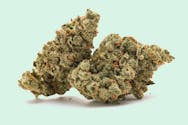
Consumers frequently report a heavy, full-body relaxation that builds gradually into deep sleepiness, making it a go-to for winding down at the end of the night. Enthusiasts also note a subtle mood lift underneath the physical weight before it settles in fully. The buds themselves are distinctive: long, fluffy, pepper-shaped nugs in minty green with purple undertones, threaded with thin red-orange hairs and coated in frosty white crystal trichomes.
A note on naming confusion: Don’t confuse Jupiter OG or Jupiter OG Kush with In House Genetics’ separate “Jupiter” strain, a Chem 4 × Goliath cross. Despite their similar names, they are genetically unrelated cultivars from different breeders.
Jupiter OG is a moderate-difficulty grow that reaches 3–4 feet indoors with a compact, bushy structure typical of OG Kush phenotypes, while outdoors it can stretch to 5–6 feet given adequate space and light. Flowering takes roughly 9–10 weeks, producing yields around 350–450 g/m² indoors and 14–16 oz/plant outdoors under optimal conditions. It thrives in both indoor and outdoor environments but prefers a warm Mediterranean climate with temperatures between 68–80°F and humidity kept around 40–50% during flowering to prevent mold on its dense, resinous colas. Nutrient sensitivity is moderate with standard OG feeding requirements, and the plant responds well to topping and low-stress training to manage its bushy lateral growth. Dense bud structure means good airflow management is essential to avoid bud rot in humid conditions.
This content is for informational purposes only.


















Browse Strains A to Z