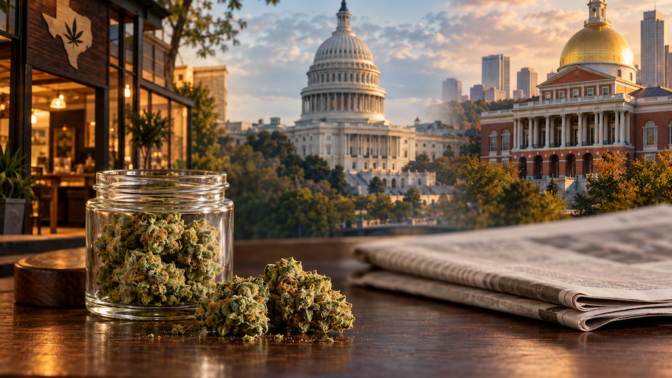
Congress has approved a new deadline for the federal hemp-derived THC crackdown, but it still needs the president's signature. Here's what the proposed delay means for THCA flower, delta-8, hemp THC drinks and edibles, and the people who buy them.
If you've ordered THCA flower online, picked up delta-8 gummies at a smoke shop, or cracked a THC drink that never came within sniffing distance of a dispensary, you've been living in the strange little kingdom Congress accidentally built with the 2018 Farm Bill.
Now Congress wants the kingdom back.
Lawmakers voted to close the hemp-derived THC loophole in November 2025, putting much of the market on borrowed time. Now Congress has agreed on a new date. The president just hasn't signed off on it yet.
As of September 2, November 12 remains the deadline written into law, but Congress has sent the president legislation that would push most of the new hemp restrictions to December 11. Until that bill gets a signature, the industry is still staring at two dates and one very expensive calendar problem.
The loophole is closing. The calendar is still chaos. Here's what actually changes, what could still move, and what it means if your weed doesn't come from a dispensary.
How the loophole actually worked
The 2018 Farm Bill legalized hemp by defining it as cannabis containing no more than 0.3% delta-9 THC on a dry-weight basis. USDA hemp rules already required preharvest crop testing using post-decarboxylation or similarly reliable methods that account for THCA alongside delta-9 THC. So growers weren't simply pretending THCA didn't exist.
The real action happened downstream.
Those crop-testing rules determined whether hemp was legal to grow, but there wasn't a matching federal total-THC standard for everything that could end up on shelves or online. Once compliant hemp entered downstream commerce, processors and sellers were operating under a federal framework still built around the statutory delta-9 THC limit.
Then chemistry met capitalism.
Delta-8 occurs naturally in cannabis only in small amounts, but it can be made by converting hemp-derived CBD. THCA flower could meet the federal statutory delta-9 THC threshold while carrying enough THCA to produce plenty of THC once heated. Hemp-derived THC started showing up in gummies, drinks, vapes, and just about every other format the market could dream up.
The result was an entire THC economy operating well outside the licensed dispensary system, built around a definition of hemp Congress wrote in 2018.
Seven years later, Congress decided it had seen enough.
What Section 781 actually changes
On November 12, 2025, the president signed the Continuing Appropriations, Agriculture, Legislative Branch, Military Construction and Veterans Affairs, and Extensions Act, 2026 (P.L. 119-37), ending a 43-day government shutdown.
Buried in Section 781 was something considerably more interesting to anyone selling, growing, making, or buying hemp THC: a rewrite of the federal definition of hemp.
1. The statutory hemp definition now counts total THC, including THCA.
Hemp is still capped at 0.3% on a dry-weight basis, but that ceiling now covers total THC, including THCA, instead of delta-9 alone. Most THCA flower sold for its THC potential blows past 0.3% total THC, so it would lose its hemp status under the new standard.
That's the THCA loophole getting the door slammed on it.
2. Converted cannabinoids like delta-8 face a separate problem.
The new definition excludes hemp-derived cannabinoid products containing cannabinoids that aren't capable of being naturally produced by cannabis. It also excludes products containing cannabinoids that can occur naturally but were synthesized or manufactured outside the plant.
That's a direct hit to most commercial delta-8, which is typically made by chemically converting hemp-derived CBD because cannabis naturally produces delta-8 only in small amounts.
3. Finished hemp THC products get their own limit.
For finished hemp-derived cannabinoid products, the ceiling is 0.4 milligrams per container, combining total THC with other cannabinoids HHS determines have similar effects or are marketed as having similar effects.
Not 0.4%. 0.4 milligrams per container.
That's a very different universe from a market where one gummy or THC drink can contain several milligrams of THC.
Cannabis seeds get caught in the rewrite, too. Under the new definition, viable seeds from cannabis plants that exceed the new 0.3% total-THC standard no longer qualify as hemp. That matters for cannabis seed banks that have relied on the federal hemp definition to ship seeds nationwide.
So what happens when something stops qualifying as hemp?
The Controlled Substances Act excludes hemp from its definition of marijuana. Once a cannabis product falls outside the federal hemp definition, it can instead become subject to federal marijuana controls under the CSA.
Losing hemp status doesn't magically turn THCA flower into legal dispensary weed. It puts the product on the other side of federal cannabis law.
Where enforcement actually stands right now
This is where Washington turns a fairly simple deadline into Washington.
November 12, 2026 is still the statutory effective date. That's one year after the law was signed and remains the deadline under current federal law.
But December 11 is now considerably closer to becoming reality.
On August 8, 2026, the Senate passed an amended version of H.R. 6500 by a 90 to 6 vote. On September 1, the House agreed to the Senate amendments, completing congressional passage. The legislation now awaits presidential action.
If signed, H.R. 6500 would push most of Section 781's new hemp restrictions from November 12 to December 11, 2026.
There's a catch.
That extra month wouldn't extend to products containing cannabinoids that cannot naturally be produced by cannabis. Those products remain on the November 12 track under the legislation.
So November 12 is still the law today. December 11 is one presidential signature away.
Meanwhile, plenty of state attorneys general would prefer Washington stop touching the clock.
On August 4, a bipartisan coalition of 35 state and territorial attorneys general, co-led by Arkansas Attorney General Tim Griffin, Indiana Attorney General Todd Rokita, Connecticut Attorney General William Tong, and New Mexico Attorney General Raúl Torrez, urged congressional leaders not to delay, repeal, suspend, or weaken the new federal hemp definition. The coalition warned that reopening the loophole could bring renewed litigation, inconsistent enforcement, regulatory uncertainty, increased youth access to intoxicating products, and disruption for businesses that have already adjusted to the new rules.
Then there's the FDA.
Section 781 gave the agency 90 days after enactment to publish, in consultation with other federal agencies, lists covering naturally occurring cannabinoids, THC-class cannabinoids, and other cannabinoids with similar effects or marketed as having similar effects, along with information clarifying what counts as a "container."
As of the most recent Congressional Research Service update, those materials had not been published.
So here we are: the loophole is closing, Congress has picked a possible new date, and some of the federal guidance businesses need to prepare for the new rules still hasn't shown up.
What this doesn't affect
For all the noise around a "THC ban," this isn't Congress banning every form of weed in America.
Licensed dispensary weed isn't what Section 781 changes. The law rewrites the federal hemp definition. State-licensed medical and adult-use cannabis already operates outside that hemp exemption and under separate state regulatory systems. Section 781 doesn't change that, and it doesn't change marijuana's federal status under the Controlled Substances Act.
Traditional hemp isn't disappearing either. Fiber, grain, seed products, and other industrial uses are explicitly protected under the new definition. Hemp-derived CBD and other cannabinoid products can also remain within the hemp definition if they meet the new requirements.
But "hemp" isn't a universal federal permission slip. The FDA still regulates cannabis-derived products, including CBD under federal food and drug law.
Other bills in play
Because one congressional hemp fight apparently wasn't enough, lawmakers have several other ideas floating around.
The Hemp Planting Predictability Act (H.R. 7024), introduced January 13, 2026 by Rep. Jim Baird (R-IN) with bipartisan cosponsors, would replace Section 781's one-year implementation period with three years, moving the effective date to November 12, 2028. Its Senate companion, S. 3686, would make the same change.
Neither bill has become law.
Then there's the Beverage Regulatory Parity Act (H.R. 10079), introduced August 10, 2026 by Rep. Beth Van Duyne (R-TX) with Rep. Greg Landsman (D-OH).
That bill takes a different swing at the problem. Instead of letting the new hemp definition wipe THC drinks out with much of the broader intoxicating-hemp market, it would carve out a separate federal regulatory lane for hemp-derived beverages, including age restrictions, a three-tier distribution system, product testing and labeling rules, THC limits, and a federal excise tax.
So Washington now has competing visions for what comes next: give the hemp industry more time, build a regulated lane for THC beverages, or let the new restrictions take effect.
Farm Bill reauthorization gives lawmakers another vehicle for fighting about all of it.
For now, proposals are proposals. H.R. 6500 is the exception: it has cleared Congress and now awaits presidential action. Unless that bill or another change becomes law, November 12, 2026 remains the statutory effective date.
What this means if you buy hemp-derived products
If your THC comes from a licensed dispensary, this isn't really your fight.
If it comes from somewhere else, start paying attention.
THCA flower, delta-8, and hemp THC edibles and drinks are right in the blast zone. The new total-THC definition puts most intoxicating THCA flower outside the federal hemp limit, while the separate rules covering synthesized or manufactured cannabinoids threaten most commercial delta-8.
Licensed dispensaries are a different lane. Section 781 doesn't rewrite state medical or adult-use cannabis programs. If you're shopping in a licensed dispensary, you're already outside the hemp market this law is changing.
In states without legal dispensaries, hemp THC has filled a very real gap. Depending on state law, THCA flower, delta-8, and hemp THC edibles and drinks have given consumers access to THC without shopping in a licensed cannabis market. The new federal definition could wipe out much of that lane.
And if you're reading a COA, stop looking only at delta-9. Check total THC. That's the number that matters under the new federal definition and gives you a much clearer picture of where a product sits under the incoming rules.
FAQ: The hemp THC rule
Does this ban weed?
No. It rewrites the federal definition of hemp. State-licensed medical and adult-use cannabis programs are separate from the federal hemp framework and aren't directly changed by Section 781.
So when does it actually take effect, November 12 or December 11?
Right now, November 12, 2026 remains the statutory effective date. Congress has passed H.R. 6500, which would push most of Section 781's new restrictions to December 11, but the bill still needs presidential approval before that change becomes law.
The legislation doesn't give the same extension to products containing cannabinoids that cannot naturally be produced by cannabis, which remain on the November 12 track.
Why does THCA flower get knocked out under this rule when it wasn't before?
The 2018 Farm Bill's statutory hemp definition used delta-9 THC, while USDA crop-testing rules separately accounted for THCA before harvest. The downstream market didn't have a matching federal total-THC standard for finished products.
Section 781 puts THCA directly into the statutory total-THC calculation and separately creates a 0.4-milligram combined limit for finished hemp-derived cannabinoid products. Both routes get closed at once.
Is delta-8 treated the same as THCA flower?
No. Most commercial delta-8 is made by converting hemp-derived CBD because cannabis naturally produces delta-8 only in small amounts. Section 781 separately excludes hemp-derived cannabinoid products containing cannabinoids that cannot naturally be produced by cannabis, along with products containing naturally possible cannabinoids that were synthesized or manufactured outside the plant.
Delta-8 gets caught by a different part of the law.
Has the FDA published the cannabinoid lists required by the law?
Not according to the most recent Congressional Research Service update. The 90-day deadline has passed, leaving some implementation details unresolved as the effective date gets closer.
Does this affect cannabis seeds?
Yes. Under the new definition, viable seeds from cannabis plants that exceed the new 0.3% total-THC threshold no longer qualify as hemp. That could matter for cannabis seed banks that have used the old hemp definition to ship seeds nationwide.
Last updated September 2, 2026. November 12, 2026 remains the current statutory effective date, but Congress has passed legislation that would delay most of Section 781's new hemp restrictions until December 11. H.R. 6500 now awaits presidential action. This is an unusually fast-moving area of federal law, and the timeline could change again. This is general information, not legal advice.